


The Economics of the Piano
by Marie T. Sullivan
Worried about AI? Consider taking up the piano.
I harbor no conspiracy theories about AI. No doubt it has excellent uses. But surely in some ways it will make us stupid: by doing our writing for us, for example. How I love this line from Evelyn Waugh’s Helena:
He [Lactanius] delighted in writing, in the joinery and embellishment of his sentences, in the consciousness of high rare virtue when every word had been used in its purest and most precise sense, in the kitten games of syntax and rhetoric.
How will a student encounter this joy if Chat GPT is writing for him? Words and writing and music make us human.
We have entered a time in which any ordinary task for which you have to take pains is intolerable. Why bother spelling correctly? Auto-correct will take care of it.
Piano playing is real. It requires effort and practice. There is no auto-correct. It also offers huge rewards down the line. Even if you don’t wind up at Carnegie Hall, you will for the rest of your life grasp the skill of a good player. Playing the piano also develops the brain, more than most other instruments because you can see the intervals before you. It’s math as well as music.
Sit at a piano, and you have real power. There, under your very hands, lies all of Western harmony. These are keystrokes no one can harvest. In recommending piano playing as a form of resistance to the techno-tyranny that surrounds us, I am not talking about an electronic keyboard. These are useful on occasion, but far from the real thing.
I mean a real instrument, with personality and unique tone quality and moods that shift with the temperature and humidity, just as those of humans do. Pianists (I am not one) report that a fine instrument whispers back to you as you play, like a lover. “You cannot interact with an electronic keyboard,” says Rich Keylard, whose family has been in the piano business for seven generations.
Piano means “soft” in Italian. The instrument was born in Italy around the year 1700, invented by one Bartolomeo Cristofori. Keyboards at that time were harpsichords and the player could not vary the dynamics. Cristofori’s revolutionary invention allowed the player to control the volume of play. He named the instrument gravicembalo col piano e forte, or a harpsichord with soft and loud.” Mercifully the name was abbreviated to pianoforte and later, piano for short. No one understands the piano business more than Rich Keylard, whose family has built, restored, sold, tuned and moved pianos since the nineteenth century under the name A.G. Keylard & Sons.
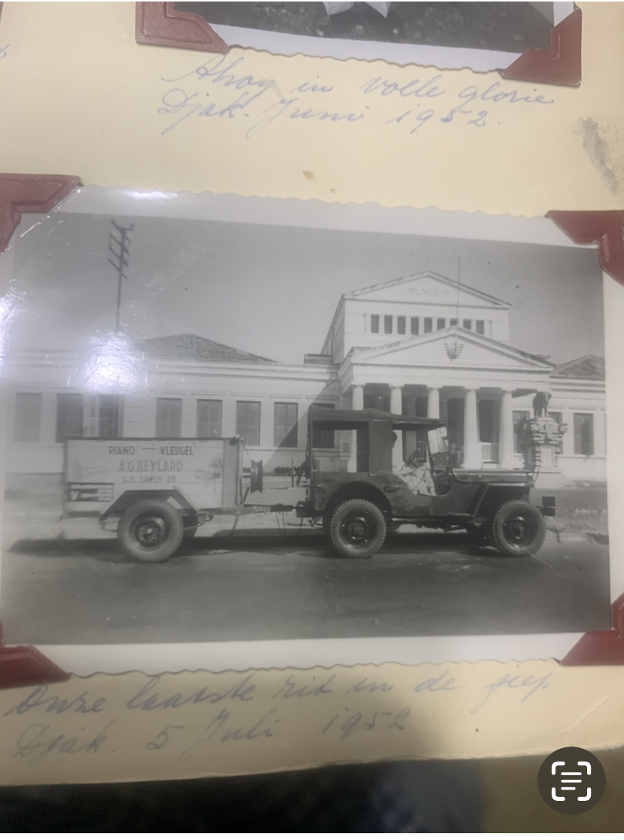
Alex Keylard’s vehicle for delivering pianos, taken in Jakarta in 1952. His wife, mother of Rich and Jerry Keylard, sits in front.
It’s a Dutch name, originally spelled Keijlard. Rich learned the business from his father. “My brother Jerry, now retired, and father were like rocks,” he says. “They felt no pain, no cold. My dad was strong as an ox. Jerry could bench-press 430 pounds. Everything in the piano business is heavy, you see.” Rich has himself been in the business for fifty-five years. “We did all of our own re-building, so the quality was consistent. We did not farm out jobs. We even used to make our own sounding boards and strings.” Rich and Jerry closed the shop and downsized in 2018, mostly for economic reasons. “Cook County taxes were definitely a factor,” Rich says. He continues the work from his garage. No longer is advertising necessary; word of mouth suffices. The firm continues to restore and sell pianos around the country.
It began in Holland. Rich’s grandfather later took it to the Dutch East Indies (now Indonesia), where plenty of aristocrats owned fine pianos.
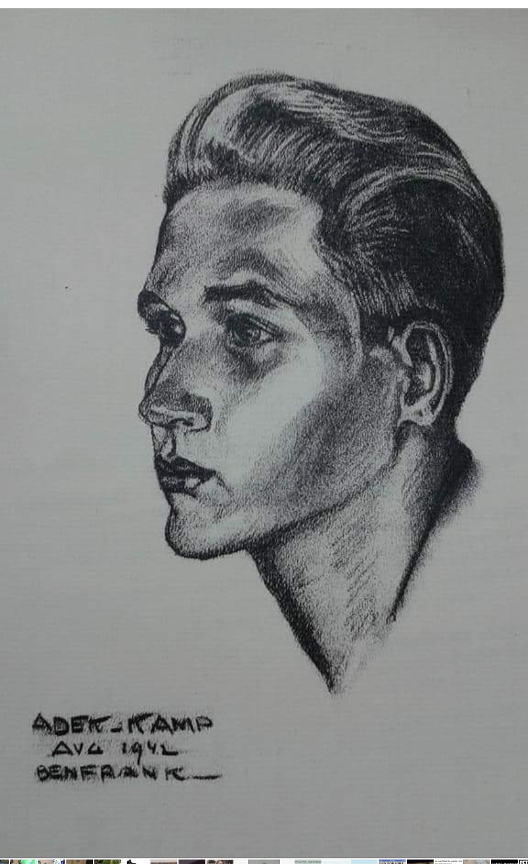
An illustration of Alex Keylard (Rich’s father) rendered by a talented fellow prisoner in prison camp in 1942.
A brother maintained a shop in Amsterdam. After the Japanese invaded the Dutch East Indies and declared martial law in 1942, Rich’s father and grandfather were taken to an internment camp for more than three years. “‘Hell on earth’ is how my father described it,” he says. “My grandfather survived only because my father was with him.” Rich’s dad met his mother in an air raid shelter. The family moved to Amsterdam when Rich was four years old.
He faintly remembers the voyage and even the ship’s name: the Somersetshire. There were too many piano tuners in Amsterdam, though, so the family applied for a visa to the U.S. and landed in Chicago.
Rich Keylard briefly summarizes piano manufacturing as follows: After the instrument’s birth in Italy, Germany became the hub of fine pianos for some time. The German firms together resolved to keep cheaper Asian products out, but one manufacturer adopted them on the sly, ruining the market. Later the U.K. became a hub, then Holland, and then Austria, home of the celebrated Bosendorfer piano, now owned by Yamaha. Then came the Koreans and the Chinese. We Americans also built pianos, but most manufacturers here did not make the effort to retool and upgrade over time, according to Rich. In the late ‘sixties, the Asian companies began buying up the names of reputable American builders and slapping them on their own pianos, what Rich calls “stencil pianos”—cookie-cutter products. “There were nine piano manufacturers in Chicago in the early ‘fifties,” he says. “All are closed.” Many pianos today are built in Indonesia and China. And some, still back in Italy. The superbly handcrafted Fazioli piano is made in Sacile, near Venice. Faziolis sell for serious prices. Look and see.
Let us turn to the iconic Steinway & Sons, located in Queens, New York and also in Hamburg. Like Faziolis, Steinways are handcrafted with great care. A 2007 documentary titled Note by Note: The Making of Steinway L1037 tells the story of one particular piano’s manufacture from start to finish. It took a full year. Standards are impeccable. Steinway maintains a selective roster of professional pianists known as Steinway Artists who have played and endorsed their instruments over time. Cole Porter, Arthur Rubinstein and Sergei Rachmaninoff are among them.
The documentary gives us a glimpse of Alaska’s Tongass National Forest, from which comes the wood used to make Steinways. It’s old-growth Sitka spruce, also used during World War II to make glider planes. A short growing season gives it a tight grain that results in the signature Steinway resonance. It’s rare, costly, and essential to Steinway’s operation.
On the stage of piano economics, enter the Northern spotted owl, an endangered species that makes its home in the Tongass Forest. It’s a small bird as owls go, but one that’s had a big impact on Steinway. In the 1990s environmentalists sued on the owl’s behalf to curb logging there, using the Endangered Species Act. The timber industry fought back, and the protracted struggle continues. Lawsuits are afoot. Steinway & Sons has no other source of the Sitka spruce.
The conflict presents a dilemma to environmentalists who love Steinways. On another front, there’s the question of elephant ivory, used in making piano keys. Obtaining it is illegal, so a black market has sprung up. Vintage ivory is available legally—from scrimshaw artists and some museums, for example—but supply is extremely limited.
Of course, manufacturers use synthetic substitutes. I asked a pianist of long experience if there’s a difference to the player. His reply: Ivory keys look better—there’s a character to the look of ivory—but are easier on the hands only for sustained, very hard playing. Another player, a Steinway Artist based in the Midwest, prefers to play on ivory keys. They are porous, and so occasionally sweaty fingers grip the keys better. Plastic is slippery, he says. A few manufacturers have developed a third way—a synthetic product that mimics the porosity of ivory.
Gone are the days when most American homes had a spinet in the parlor, as in the late nineteenth century. But civilization is not dead, and there is still a market for pianos. In our country, Rich reports, “kids are starting to play more, but often they are kids whose families are from other countries: India, Asia, Poland. A lot of American kids go for sports. It’s hard to do both.”
There’s another form of economy related to the piano that is not monetary. It’s in the jazz world, with which I am familiar. It’s economy of playing, not unlike the “kitten games” of the writer choosing exactly the right words. Improvising jazz pianists want to choose the best notes in a given moment. Doing so to good effect takes a deep knowledge of harmony and years of training and experience. Humans have ten fingers. Normally only up to eight of them are used at once when playing chordally. You can define a jazz chord with as few as two notes. As with words, sometimes fewer is better. So, using all that experience, the jazz player makes split-second microdecisions as he plays. Which notes of the chord will I choose right now? Which in the right hand and which in the left? At the same time, they decide how to “voice” the progression for smooth movement that is both logical to the hand and pleasing to the ear.
The tuning of the instrument they play affects their split-second choices, too. A fine jazz pianist I know reports that when he is compelled to play an out-of-tune piano, he quickly and unconsciously adapts to avoid the bad notes, like avoiding the mushrooms in a casserole.
So, find an instrument, tune out the world and play something simple to start. Besides, a good piano will outlast you. Its life span is some forty years and then you have it rebuilt, extending its life by another fifty. Would that we could do the same.
-30-
An Ohio native, Marie T. (Terry) Sullivan has lived in Chicagoland for all of her adult life. Her background is in music. For two years she served as culture editor for the now defunct Chicago Daily Observer.
Comments 25
Happy New Year John. Keep up the good work, and I wish you and Betty a very Happy New Year full of love, health, happiness and prosperity and your boys of coarse.
Happy New Year.
Happy New Year. And thank you, thank you, thank you. I retired 5 years ago. I began playing the piano 2 years ago. What an incredible journey. There is no feeling describable as playing the piano.
To feel your fingers drifting almost without weight across keys and hearing music play. Playing right in front of you and knowing that you are the creator of these seamless notes.
Unless you can do this on your own there is no explanation of the joy.
I look forward to another year of playing and of course reading. Reading your columns. Please keep your guest writers afoot. They bring a lot to the table. Marie’s column by far is a shining example.
Wish I had inherited my mom’s ability to play piano. However, maybe the genes followed, and I did become a drummer.
Paul, like you I took up a musical instrument (electric bass guitar, not piano) as I approached retirement. What a joy! Been taking lessons for 7-plus years. My journey has introduced me to a whole group of folks (musicians and other artists) that I likely wouldn’t have come to know and enjoy. Heck, I’m even playing regularly in a church band. Not bad for a septuagenarian deaf in one ear.
To play an instrument is wonderful. Music is a joy! Yes, just listening is not the same. Best wishes!
This story is making my day. I appreciate the hope and quality of manufactured things and well written words that I see in this story. I appreciate the efforts of musicians that you write about here. Thank you for the story about the Keylards.
Thanks!!! As usual, the piece is superb. When I was a kid (am now 77) living on Normal Ave, my mom played a Steinway baby grand. What a joy it was for her to play and well did Christmas carols together.
Just added Chris Rae’s Driving Home for Christmas to my playlist, as the memories flooded in when I first heard it.
Thanks again. Happy New Year to all.
Wish I had inherited my mom’s ability to play piano. However, maybe the genes followed, and I did become a drummer.
I forgot. I appreciate what you say about AI.
We have a 1933 Mason and Hamlin. It’s beautiful. Mason and Hamlin have different soundboards that produce a different sound than the Steinway. Ironically, it has the Marshall Fields logo on it. It sits in my house here in Las Vegas. My daughters used to play, but now, it’s silent. Maybe I should learn.
Mason & Hamlin was making fine pianos in that era–or so knowledgeable pianist friends tell me. Wonderful that you own one.
Yes, you could learn, starting with the simplest of pieces!
Jeffrey, look on the iron harp and see if your piano is a model AA. If it is and it was built in 1933 as you claim, then that’s a serious piano.
Ms. Sullivan’s essay is inspired. Her “. . . a fine instrument whispers back to you as you play . . .” made me recall a long-ago performance of a Brahms piano Intermezzo. All of us in the audience seemed mesmerized by the wondrous little message on a keyboard.
If you’re interested, here’s another performance of that piece. It reflects the ethereal “economics” Sullivan expertly describes.
https://www.youtube.com/watch?v=fo0mEyRnnb4&list=RDfo0mEyRnnb4&start_radio=1
David,
This performance you sent is a perfect example of the sweet conversation between man and quality instrument. Economy of playing, no baloney, utterly truthful.
In turn I recommend the Brahms Intermezzo in A Major, op. 118 no. 2, one I heard in music school many moons ago. It’s based on three little notes. One of the loveliest works I know in any medium.
I’ve attempted to attach a link but am repeatedly foiled–my computer apparently was offended comments about “techno-tyranny.” But you can find it.
Marie,
My computer often foils me, too, but apparently it is pro-Brahms (and after many years it’s learned to be strongly pro-Mahler). However, it does allow the link to your Intermezzo…#2, so I hope other JKNers enjoy it as we do.
https://www.youtube.com/watch?v=doSSutlNfXI&list=RDdoSSutlNfXI&start_radio=1
Again, thanks for your sublime essay. It actually helped me adjust the tone of something I’m writing now (more heart, less spleen).
David, thank you for posting this. Not to fuss but for the sake of conversation, I prefer a male performer for such a piece. The contrast of strength with the gentleness of the theme is greatly appealing. The example you first sent above shows that in spades!
I’ll be excoriated for saying this, but there you go. Again, thanks.
Marie, like most insightful writers, you are obviously brave by nature and celebrated by wise readers, even if ever excoriated by some tone-deaf critic. But here you are featured on JKN, which celebrates actual insight, not the Hedge Fund Tower Remains, which excoriates incorrect opinion. All good!
Lovely stuff Terry.
Houli
John and Ms. Sullivan, thank you for the reminder. Our piano was an upright Wurlitzer. It was wedged in the corner of our living room. With a baker’s dozen of 9 girls and 4 boys, growing up in the 60s and early 70s, that piano was the main entertainment, besides the tv. While my 5 older sisters all played, Kathleen and MaryKay the 2 oldest, were by far most accomplished. From Brahms to the Beatles, with show tunes from “Oklahoma”, “Guys and Dolls” and “Brigadoon” in between, they played and we all sang…. Alas, time moved on like it always does. Mom and dad downsized and there was no room for the piano in the condominium. Mary Kay and Kathleen are no longer with us. But whenever I am back in Chicago, I often drive by the house at 10444 S. Kedvale, I think I can hear a piano playing the opening chords to Stephen Sondheim’s: “Send in the Clowns.” Isn’t it rich!
The primary danger of AI becoming more and more part of the arts and sciences is that one day we will not have anyone left who knows what BS looks like.
Thanks for your thoughtful essay.
Yes, Piano! Any music, craft, art, writing, but especially making music, especially with others! There are so many benefits to immersing oneself in the arts, especially music.
Music is so beneficial to children, the concentration, focus, discipline it requires translated to many other necessary pursuits like learning and WORK!
AI will make us dumber. The internet has done so to a certain extent already.
Thomas Jefferson played many instruments, was conversant in many languages, was a scientist, botanist, architect. He didn’t have social media to waste time on.
I don’t know where this AI the tech ghouls and the oligarchs are foisting upon is will ultimately go, but I’m pretty sure some suffering and anguish will result for ordinary, unconnected workers.
It will behoove any young person to be physically and mentally fit in order to take advantage of opportunities that may arise. Some careers have not been invented yet and may come from mm this new tech.
They should learn carpentry, plumbing, electrical, welding. How to use tools as these jobs cannot be outsourced or done by a computer, at least not yet.
Music can unlock all sorts of potential.
Last, prayers to Victor Davis Hanson. He is respected by many and I’m sure loved as well.
Thank you
I have no musical ability, but I do love jazz piano, particularly Keith Jarrett and Bill Evans. Jarrett in particular was extremely picky about his pianos.
As a piano teacher of forty-five years, I can say with authority that the greatest detriments to children learning piano are gaming, social media, and the ubiquitous cell phone. It’s much easier for a child to press a button on their iPhone and instantaneously get what they want rather than spending long hours at a piano where effort is required and there are no shortcuts to learning.
What a delightful article and informative as well.
Thank you, Marie