


The Mother’s Day We’ll Never Forget
By John Kass
May 10th, 2026
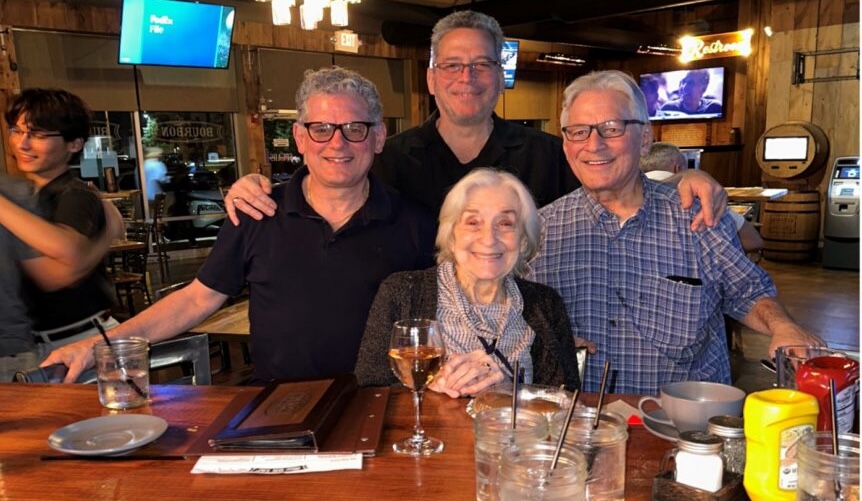
I think you know the gruff old guy on the right. He might talk tough but he’s really a big baby. You may also know his brothers: Nick, the senior retired American intelligence official, and Peter, the Chicago businessman, on the left. The elderly woman in the center is so happy, surrounded by her sons at a family gathering prior to her 95th birthday last year.
But I see them as they were, once, some sixty years ago on a thick, rough, red hand-woven Greek village blanket on the edge of lagoon in Chicago’s Sherman Park on the edge of the Union Stockyards. I think of a sunny, cool autumn afternoon and that mother and her children in the sun.
The woman wore long shoulder-length auburn hair and dark hose, brown leather walking shoes, a green tartan plaid skirt and a brown turtleneck sweater.
They had small boxes of animal crackers for snacks and there were books on the blanket, books about knights and Childe Harold and The Goblin King.
She was a Canadian by birth. Her father had fought in both WWI and WWII.
As a young girl from Guelph, Ontario she’d listened to the German bombing of London on the radio, and so she was a daughter of the British empire, and taught us, her boys, to sing “There Will Always Be an England” and “God Save The Queen.”
They took up their books, reading aloud, sounding out the more difficult words, using context to begin ferreting out the meaning of phrases like “windershins.” Young knight rode windershins (counter clockwise) around the tower, which was was their key to find entrance to the Goblin Kingdom and face the cruel Goblin King.
I don’t know where people got the idea into their heads that she was some old Greek widow in black. Not from me. I suppose it is easier for some to think in stereotypes and thinking of her as some old crone from an isolated village is just too easy. She loved the arts and fine music, Maria Callas was her favorite. She loved the theater and English literature. She introduced us to Kipling. She is the reason I became a writer.
Yes, she was of Hellenic heritage. Yes, she was a widow. She wore black for a year, then put away her widow’s weeds. She had life to live, waiting for her grandchildren to be married.
She was a lady. She didn’t go out dancing or wear red dresses and seek male companionship after she lost my father. She loved my him, her family, and our name and would never besmirch it.
She had the Nicene Creed as her authoritative statement of her Greek Orthodox faith. And she also believed in another strict code that she used as a weapon against incivility:
Propriety.
Without good manners we would descend into barbarism like so many other failed cultures.
“If there’s one thing that drives me mad it’s bad table manners,” she’d say. “When I see people with their elbows on the table, chewing with their mouths open like cattle, sawing at their beef, grabbing the fork as if it were a spear,” she said, flaring her nostrils. “It drives me mad.”
Yes, mom, I know.
Yes, Yia-Yia, we know, the boys will say.
There is a proper way to serve tea and not be ostentatious about it. She loathed ostentatious behavior.
And if you dared put open jars of jam on the table and stuck spoons into the jars to serve your guests, you might hear the word “barbarian” from under her breath. And you’d regret it. Forever. And the nostrils would flare.
Because we call her Yia-Yia, some readers mistakenly think she’s a little old Greek widow with an accent, as if from a Greek yogurt commercial. She’s not. But she has let her hair grow white.
She speaks Greek and English and the two cultures have created in her a sense of propriety: stand up when your guests arrive, turn off the TV, greet everyone by name, look them in the eye, write thank-you notes and mean them— those are just a few.
To do what’s expected. To not do what isn’t done. This sense of propriety, this melding of two old cultures, the fear of shame and certain knowledge that a family’s name, its honor, aren’t just about words, have been forged in her like some alloy of steel.
And she instilled that in her sons.
When my father died, Betty insisted she come to live with us. And later when Betty was expecting the twins, mom quit smoking cold turkey. She quit.
She spent 25 years with us, transferring all her knowledge to my wife and sons. How to cook, the respect for traditions and how to treat guests. Yes, there is a proper way to set a table. Some had Martha Stewart to teach them. And our modern culture invented Martha to teach them. I don’t know if many even care these days. Perhaps all that is lost in the culture now, to be searched for like the Grail, as if proper manners are hidden treasure to be discovered again.
And I wonder: How many people have been as lucky to have several generations in the same home?
We were lucky. And I was lucky as a boy on the South Side of Chicago, on Peoria Street, with our extended family living up and down the block in two-flats, multigenerational. A tribe.
Betty didn’t want me to mention it, but a wife and mom in the same home for 25 years was a challenge, especially for me, when they’d tell me what to do.
I’d say, the mayor, the governor, the Outfit doesn’t tell me what to do. They’d just laugh.
But there are also untold benefits. Some people move as far away from family as they can. When the children come, they keep a distance. I’m not judging them. I just can’t grasp it.
When Betty was finishing her master’s and I was all-in for the Tribune at City Hall, mom would feed the boys breakfast before they went to school. She would tell them stories. She was always a great storyteller.
She wanted to be a journalist until she tagged along with an older reporter on a story that involved the great Joe Louis boxing a drugged bear at a county fair.
Louis had been a hero of hers — she’d heard his fights with Max Schmeling on the radio, Louis for America and Schmeling for Hitler’s Germany — so to see Louis boxing a bear in a dirt ring broke her heart and soured her on journalism forever.
But she did tell the boys stories — of the Three Little Pigs, of Childe Harold and the Goblin King, of the early Christian martyrs. And Russian fairy tales because they were so exciting and violent and stories of Odysseus and his faithful dog Argo. She made sure we had the full collection of the “My Book House” books, hardbound and beautifully illustrated.
I’d once written a column about how important that 12-volume collection is, but I can no longer find it online.
She’d tell stories of our family: of my dad, plowing his fields with a mule named Truman, and the night the Carabinieri came for him during the occupation. And an elopement in the village where her father was born, which brought out the men with guns and lanterns. And other tales of revenge, and of Christ and the Christian Martyrs and the Holy Greek Orthodox church.
And the story she told my brothers and me, she also told my sons, about the thief about to be hanged who asked to kiss his mother goodbye and bit off her ear, explaining she let him steal an egg — then a chicken, a goat, a cow, a horse, and then gold. Or the story of the village lad seeking favor with the king.
All our mothers teach us what’s important. And what’s important to them might just become important to you.
Happy Mother’s Day.
As I was writing this, my brother Peter called with an edge in his voice. The nurses at the Greek American Nursing Home in Wheeling reported Mom suffered another stroke, a bad one.
But she had been adamant about not jabbing her with more needles and unnecessary procedures. She wanted to preserve her dignity and pass on without unnecessary pain.
She had a DNR drafted by lawyers. So, now the family gathered around her to wait and pray. And wait. My brothers and I were at her bedside,
Some of you have been through this. I have not. I’m sorry for my confused thoughts.
But if there’s one thing she’d ask you, it would be to spend time with those you love and who love you. It’s all about love.
We think we have time to spend, until we don’t, until we can’t.
Funeral services and visitation for Betty Kass, 95, are scheduled to begin at 9 a.m. Wednesday at St. Nicholas Greek Orthodox Church, Oak Lawn., with internment to follow at Evergreen Cemetery, Evergreen Park. In lieu of flowers her family ask donations be sent to Greek American Rehabilitation and Care Center, Wheeling, Ill.
-30-
 About the author: John Kass spent decades as a political writer and news columnist in Chicago working at a major metropolitan newspaper. He is co-host of The Chicago Way podcast. And he just loves his “No Chumbolone” hat, because johnkassnews.com is a “No Chumbolone” Zone where you can always get a cup of common sense.
Merchandise Now Available: If you’re looking for a gift for that hard-to-buy for special someone who has everything, just click on the link to the johnkassnews.com store.
Where else would you find a No Chumbolone™ cap or a Chicago Way™ coffee cup?
Because I know this about you: You’re not a Chumbolone.