


Beware of Geeks Bearing Grifts: Nolan’s Cowardly Betrayal of The Odyssey and the Greek People
By John Kass
Sunday July 26, 2026
The Odyssey of Homer is an intensely personal book for me, the most important book of my life. It is the foundation of the Western cannon. When we become lost in the chaos of our time, we follow it like breadcrumbs to get home.
But cultural history isn’t what drew me to Homer’s Odyssey. It was the man’s search of his family and his kingdom. The son’s search for the father. The father’s search for the son. It is the deeply human story of our desire to go home again. All western literature flows from this root which is why the left must destroy it.
And it was put into my hands by the gods.
Loyal readers know this about me: I was 11 years old in 1967 when the great Oak Lawn tornado ripped through the Southwest suburbs of Chicago, killing 33 people, destroying homes and schools. My parish St. Nicholas Greek Orthodox church had a school and classrooms and these were opened to the students from tornado-devastated schools. And in one of the desks I found it:
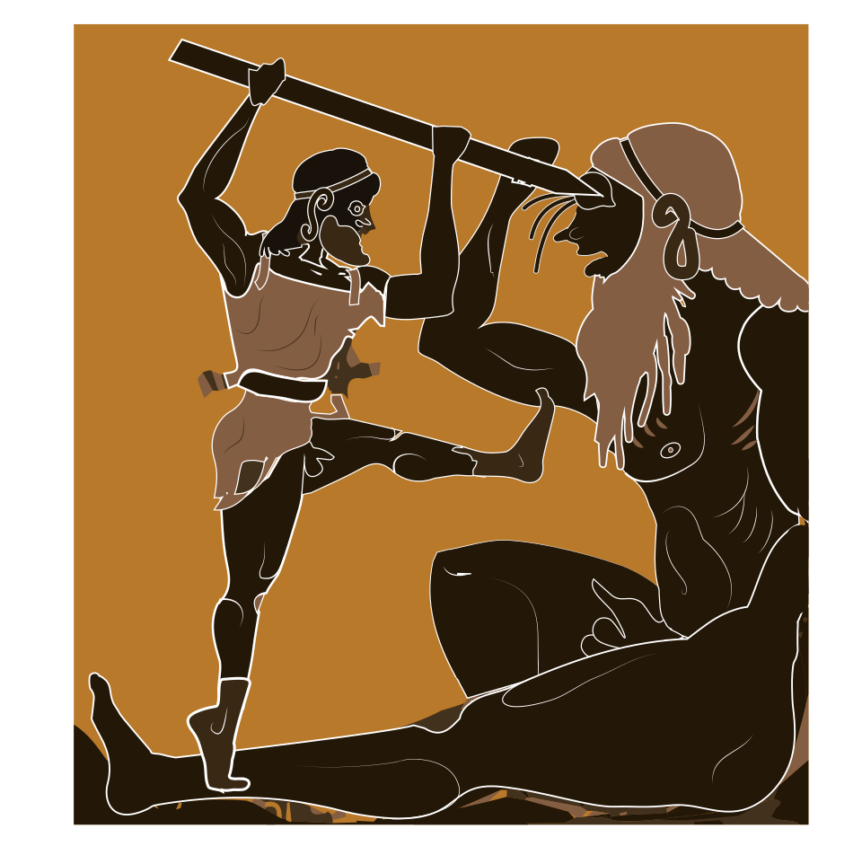
A boy’s version of the Odyssey—Odysseus the Wanderer by the well-known classicist Aubrey de Sélincourt. I took it, and as the rest of the class conjugated verbs, I hid it behind my textbook and began reading it, greedily and got lost as Odysseus’ crew babbled and panicked as the giant cyclops began eating them alive in the cave. I never apologized. And I never looked back. The national epic of the Greek people had been offered to me as other immigrant sons were giving themselves up to the Great Melting Pot. The kid I stole it from was Irish. Zeus put it in my hands. And though I am 70 now, and crippled from a stroke, if he showed up at my door demanding return of that book, I would happily fight him for it.
Some pilgrims latch onto the Bible for their journey, but as a boy, sadly I was not drawn to the Good Book. It was too kind, too good, and so, instead, I was drawn to the sacker of cities, the cunning man of many devices, the Son of Laertes, the trickster called Noman, the Man of Wrath.
How personal of a book? The Odyssey compelled me to go to down to the sea alone when I was a boy of 19, to the jungles of Guyana where Pastor Jim Jones would command a thousand followers to commit suicide, and later to the crowded violent chaos of the oilfields outside Wari Nigeria, and the criminal gangs of Lagos, and to the gales of the Bay of Biscay,
But now there is a movie version based on a woke feminist translation. What do I think? It is a coward’s version of a great story. It is worse than I expected. It is feminist trash from a woman who hates the patriarchy. Based on someone who hates the king of Ithaca. And I’m not the only one. It sucks, homerically, epically.
The Odyssey Was EVEN WORSE Than I Expected. Here’s Everything Wrong With It. pic.twitter.com/AXmDmP92GF
— The Matt Walsh Show (@MattWalshShow) July 22, 2026
The Problem With Nolan’s Odyssey Is That It’s Not Homer’s Odyssey
By: Nathan Stone
July 24, 2026
6 min read
e the Odyssey relatable to the twenty-first century, Nolan made a flash in the pan, not an adaptation of foundational text of the Western world.
The best way to describe Christopher Nolan’s The Odyssey is to say that it is a sleek, modern piece of porcelain, delivered without the medium ribeye you ordered.
The movie, like all of Nolan’s work, is a technical marvel and the first narrative film shot completely on IMAX 70mm film. Chock full of household names, both old-school (Matt Damon, Anne Hathaway, Charlize Theron) and newcomers (Tom Holland and Zendaya), the blockbuster is reminiscent of old Hollywood star-fests like Sidney Lumet’s Murder on the Orient Express and John Huston’s The List of Adrian Messenger.

Excellent scenes are seeded throughout the movie. Odysseus’s encounter with Circe, for example, is genuinely horrifying, ditching mumbo-jumbo spells and Harry Potter-esque transformations for elements of classic body horror flicks like Cronenberg’s The Fly. The brief reunion between Argos, Odysseus’ faithful hunting dog, and his master is genuinely heart wrenching.
When Odysseus slaughters Robert Pattinson’s Antinous and the other men who perverted the laws of hospitality and squatted in his home to woo his wife Penelope, it is a cathartic experience to watch. While there are highlights in the two-hour, 52-minute runtime, the product still has serious flaws.
Nolan’s adaptation is not Homer’s Odyssey. Yes, the exterior details are there — we have the Trojan Horse, the Cyclops, the Sirens, Calypso, the lotus flowers, Charybdis and Scylla — but none of them are right. It is as if Nolan took these elements of the epic, dropped them in front of a funhouse mirror, and shot their reflections. The reproduction is shallow, but not because the dialogue is modern or because there are more black and Indian people in the movie than Greeks. It is because Nolan completely drops the ball in delivering the theme of the poem.
Mythology can be a nebulous entity with several legitimate interpretations. Many people will say the theme of The Odyssey is about “homecoming” and the dangers and sacrifices a man must make to return to the people and places he loves. This is a legitimate take, but it only scratches the surface.
In his 2008 book, The Wisdom of the Myths, Luc Ferry argues Odysseus is a man overwhelmed by chaos. Some of this chaos, like the 10-year Trojan War, is out of his hands; duty forced him to follow King Agamemnon to war. Other chaos, however, like the hatred Odysseus earns from the sea god, Poseidon, comes from Odysseus’ own pride and vanity. This chaos is sparked by what the Greeks called hubris, acting in some way like something you were not, usually a god.
The gods threaten to kill Odysseus, not merely physically but by erasing his identity, making him as nameless as the dead. In the book, when Odysseus communes with the dead and speaks to Achilles, the great warrior says, “I would rather work the soil as a serf on hire to some landless impoverished peasant than be King of all these lifeless dead.”
The Odyssey is not just a story about a man trying to find his way home. It is the story of a man who must bring order out of chaos. He must hold fast to who he is — Odysseus of Ithaca, son of Laertes, the beloved of Athena — when gods themselves thwart him in this task. Reclaiming his identity, according to Ferry, is why so many of the dangers Odysseus encounters attack not just his body, but his memory and identity. Only by remaining Odysseus, “the man of nimble wits,” can he return home and re-establish order.
Nolan throws all this away and, instead, gives us a contemporary reflection on guilt. According to his movie, Bronze Age Greece collapsed because the guile of the Trojan Horse shattered “Zeus’ law” of hospitality, which rendered all morality moot. While it is true that Homer’s wise man, Nestor, tells Telemachus, Odysseus’ son, that Zeus wrecked the homecoming of the Greeks because “not all were wise and just,” the Trojan Horse itself was never the problem. The Greeks adored cleverness, and the Horse was sanctioned by the goddess Athena. Turning the trick into the moral failing ruins the entire retelling.
Take Odysseus. Matt Damon’s Odysseus cannot be the “man of nimble wits,” because while wits give you an edge over your enemies and keep a lock on your identity, they can do nothing in the face of overwhelming guilt. Cleverness is thus replaced by angst.
Damon is a PTSD sufferer who wants to forget. He pigs himself on the lotus flowers and, at the end of the movie, after freeing his house from the suitors, exiles himself with his wife to the west as if he were a scapegoat. Nolan intends for this to be a heroic, self-sacrificial action. But it comes across as the easy way out. If Odysseus is guilty, his exile should be more of a mission to re-establish Zeus’ law. And if he isn’t guilty, then this decision is asinine stupidity.
Guilt could have worked cinematically as Nolan’s theme if the Greek gods were actually present in the movie and had a say in things. But they do not. While monsters and seers and witches seem to thrive, the gods, the forces of order and justice, are MIA. Yes, Zendaya is credited as Athena, but the actress’s appearance as a Trojan girl killed in front of Odysseus suggests she is just a guilt-induced manifestation. Zeus is mentioned but never appears. The thunder supposedly heralding his presence might as well be a meteorological coincidence. Ignoring the pantheon, especially in one of the two main works that gave the Greek their gods (Herodotus names Homer and Hesiod) is not just an error, but borders on sabotage. And for what?
Here is where the true irony manifests. By trying to make The Odyssey relatable to the 21st century, Nolan made a flash in the pan, not an adaptation of one of the foundational texts of the Western world. Instead of a hero we all can relate to — because home and identity and stability are things we all crave and desire — we get another story about another soldier who feels guilty about fighting in a war. That might have been a unique spin in 1971, but it’s as old as mothballs today.
While the movie looks like it will make money, and the supermajority of critics cannot contain their joy (actress Samantha Morton wins the hyperbole Olympic gold for calling her experience on set a “religious experience”) it is, at the end of the day, a Pyrrhic victory. A white, porcelain plate cannot satisfy what we look for when we read Homer, no matter how smooth or flawless it is.
Nathan Stone is a storyteller who looks at culture, politics, and religion from a different point of view on his YouTube channel Nate on the Stone, and who exercises moral imagination in his writing. A lover of bo
Notes
Notes cont’d
e was one where Don Draper was presenting the Kodak slide projector, “The Carousal.” In it, Draper pitches the product by telling the story of his friend Teddy, a Greek merchant who told him the true meaning of the word, nostalgia. Teddy said that in Greek, nostalgia literally means pain from an old wound, and a retuning home. This scene had me stopping it and rewinding it several times as it affected me on so many levels. First, it reminded me how beautifully complex and specific the Greek language is. Secondly, it reinforced my own strong relationship with nostalgia. A longing born out of a connection to history, home, friends and family. Lastly, I was able to relate the show yet again to The Odyssey.
Displaying family slides of his children in a darkened room to his clients from Kodak, Draper ends his sales pitch by comparing the way the slide projector works to the way a child might play, going around and around, backward and forward, and finally returning home to a place where we are loved. This simple message of memory as a combination of love and pain enriches us all. There’s an old Greek saying,
“A man travels the world over in search of what he needs and always returns home to find it.”
Going home, the place we all ache to return to is how this story, and all my favorite story’s end.
END NOTES\
Universal studios whipped up its publicity machine and it spit out what the suits wanted any criticism is steeped in racism.. but there is one critic who counts:
Elon Musk
Before this year ends, Grok Imagine will make a full-length movie of The Odyssey that is historically accurate and true to the art of Homer https://t.co/bVHzUmY9WN
— Elon Musk (@elonmusk) July 22, 2026
-30-
 About the author: John Kass spent decades as a political writer and news columnist in Chicago working at a major metropolitan newspaper. He is co-host of The Chicago Way podcast. And he just loves his “No Chumbolone” hat, because johnkassnews.com is a “No Chumbolone” Zone where you can always get a cup of common sense.
Merchandise Now Available: If you’re looking for a gift for that hard-to-buy for special someone who has everything, just click on the link to the johnkassnews.com store.
Where else would you find a No Chumbolone™ cap or a Chicago Way™ coffee cup?
Because I know this about you: You’re not a Chumbolone.
Comments 2
Thanks John Kass for exposing this latest Hollywood hoax. The film embraces the same leftwing trends as Obama’s lakefront monument to woke obsessions.
Nolan used the elitist strategy we see in Super Bowl halftimes : embrace fringe groups while ignoring longtime fans. His IMAX opus magnum appeals to every culture except Greek-Americans.
Ironically, it seems Nolan employed very few Greek technicians, even while filming in Greece. IMDB website lists 19 overseas filming locations. Only 6 are in Greece. The rest are in Morocco, England, Scotland, Iceland or Sicily. Of the ten producers, only Kostas Raftopoulos has a Greek-sounding name.
Of the 74 actors listed in IMDB, less than ten have Greek-sounding names. By comparison, Nolan hired numerous liberal activists including Senator Elizabeth Warren’s fundraiser Matt Damon.
Other woke types on the payroll include Elliot Page, Zendaya, abortion enthusiasts Charlize Theron & Anne Hathaway, hip-hop mogul Travis Scott and John Leguizamo who posted January 28 “If you follow ICE, unfollow me. Don’t come to my shows, and don’t watch my movies.”
John, I wondered when you were going to tske Nolan to task as for abusing such an important part of Western Literature and Civilization! I have not watched it, and do not plan to do so, as it will nowhere near do it justice, as so many Hollywood productions of historical literature do, to the book it is supposedly derived from! I do want to encourage you to go back and read the book of Genesis in the Bible, as its human storylines are just as gripping (and also real history) as Homers. The only positive with Nolans’ work I see is at least some people will know that a Greek guy named Homer wrote an ancient tale, which is more than they teach in most Woke college English courses!