


The Scourge of Bad Church Music
By Marie T. Sullivan
Sunday September 13th, 2026
In my youth, after years of post-college wandering, I resumed going to church.
A kind friend, learning that I was a lover of the fine arts, steered me to a traditionalist Catholic parish in Chicago. I was struck by the sheer beauty of the place: the art and architecture, the choirs, the incense and snow-white altar linens, the dignity of the movements on the altar.
What kept me there, after the initial lure of the beauty, was the faith itself. But that’s another story.
For many, the fine arts furnish a pathway to religious faith. They can lower the gates of resistance for the most hardened atheist, if no foxhole is at hand. They speak of God without words.
I have seen beautiful churches of various denominations, but write here about the beauty of Catholicism, with which I am familiar. All matters of doctrine aside, in its more traditional forms it offers a feast of the fine arts. It has been called the most sensual of religions, serving the eye, the ear, the sense of smell: all that lovely incense and candle wax. The late Dennis Martin, a distinguished professor of history and theology at Chicago’s Loyola University, once pointed out that Catholicism’s sensuality is one reason it is viewed with suspicion by Protestants.
Of all the beauties music is the most powerful, according to Peter Kreeft, the celebrated professor of philosophy at Boston College. It reaches into the human heart the most deeply, he said. Asked why in a live lecture, he replied: Historical evidence. “One of your obscure modern scholars has shown that social and political revolutions have usually been preceded by music revolutions,” he wrote. “Another sage said ‘Let me write the songs of a nation and I care not who writes its laws.’”
For better or worse, Dolly Parton’s “Nine to Five” fueled a movement.
“Music is more powerful than reason in the soul,” Professor Kreeft adds. “That is also why Plato made music the very first step in his long educational curriculum: good music was to create the harmony of soul that would be a ripe field for the higher harmony of reason to take root in later.”
The treasures of sacred music are rich, voluminous and written by the finest composers in human history. Tomas Luis de Victoria, a sixteenth-century priest-composer, is one shining example. Years back the English vocal ensemble The Sixteen created a film about Victoria called “God’s Composer.” Its renowned director, Harry Christophers, points out how the soaring musical lines of Victoria’s music mirror the architecture of the churches in which his music was sung, with its vaulted arches, to evoke the transcendent and give the closest thing on earth to a tiny glimpse of Paradise.
The website Aleteia once ran an article titled “Why the Devil Hates Sacred Music.” Answer: Because it’s the music of Heaven.
I recall hearing of a survey of fallen-away Catholics, asking why they had left. Surprisingly, the top reason was not any particular issue. It was that they simply drifted away. One suspects they were driven away by the music they heard in many Catholic churches in the United States, which compared to the music of Victoria is as a Hallmark card to the Mona Lisa. Bad church music is equivalent to a Hostess Twinkie; it fails to nourish. Its only value is that hearing it is penitential, and suffering through it may help you atone for your sins. It also gives you a good look at Purgatory so you won’t want to go there.
This viewpoint is not elitist. We want good music in church for the same reason that chalices are made of gold.
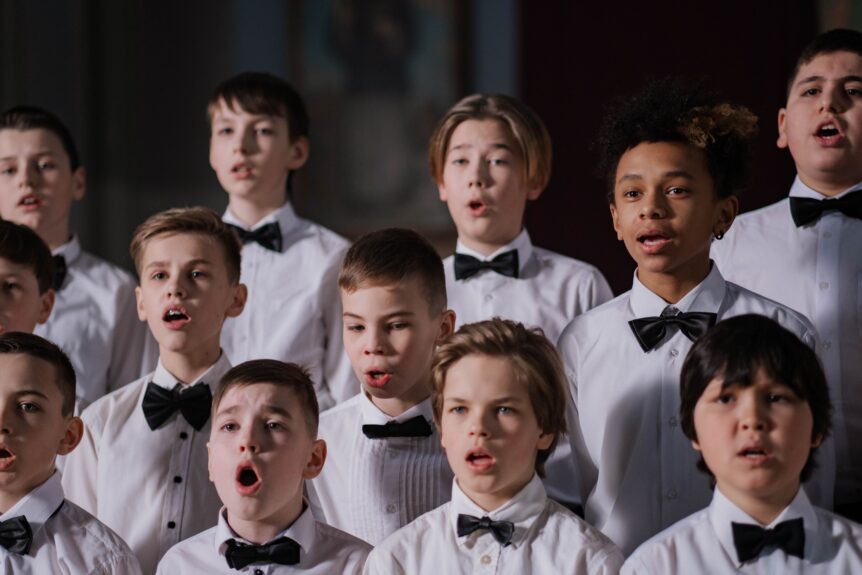
We need more choirs in churches, singing quality repertoire. They need not be composed of professionals. Capable volunteers can make a beautiful sound, and there are libraries of fine choral literature waiting to be sung. For those of simpler taste there are simple works, like good hymns. Children’s choirs too can sing so beautifully as to make grown men weep. Sacred choral works abound that are high in quality but easy to sing. As a bonus, the texts of great sacred works inhabit you when you sing them repeatedly, and remain within you. Kids in particular are unlikely otherwise to be exposed to such enriching textual fare. Singing in the choir feeds their little brains.
A far-fetched analogy. Remember the ‘Fifties, when most coffee served in America was bland? With the democratization of air travel in succeeding decades, more and more Americans flew abroad, went to cafes in Paris and Rome and experienced a first-class cup of coffee. Wow. “Why can’t we have this at home?” they asked, and went home and learned how to fix a great cup of coffee. The Gospel of Good Coffee spread throughout the land. Now there is a Starbucks on every corner.
Surely we can do the same with church music in the United States. Embrace quality and democratize it, so that one needn’t travel great distances to hear it. Let it be done not as a performance, but done well nonetheless, and in the service of the service.
Doing so can help fill pews.
“How will we understand each other in Heaven?” asks Peter Kreeft. “Will we all speak English, or Dutch, or Latin? No, we’ll all speak music.”
-30-
An Ohio native, Marie T. (Terry) Sullivan has lived in Chicagoland for all of her adult life. Her background is in music. For two years she served as culture editor for the now defunct Chicago Daily Observer.
Comments 34
Got is great. Getting ready for Church. Love the Greek Orthodox Churches full of the Glory of God.
Eons ago, when I was a student at Southern Illinois University, my good friend, Peter Dunn, a semi-devout Catholic, and I attended mass every Sunday morning. We then went to the Presbyterian service, that had the best music on Sunday morning in Carbondale, Illinois.
Nothing better than finding our choir leading us in great music. Of course, the opposite is sometimes what we find instead;)
Could not agree more, great music makes the Mass come alive!
The beautiful music of the church. Just ready to walk out the door headed to our 8:00 a.m. service at our Immanuel Lutheran Church in Downers Grove. Was there yesterday and heard our organist practicing on our beautiful pipe organ for the services today. It will be a lovely morning! Wherever YOU are, join in the Songs of Praise….God is Good. Blessings to all.
I went through K-12 in public schools and sang in chorus and a cappella choir for just about all of those years. Back then when it wasn’t a micro aggression to call the December holiday “Christmas”, there were always programs that featured music that would’ve been right at home in any Christian church. Such great memories and a starting point for inquiry into the deeper meaning behind those hymns.
I’d love to be proven wrong, but I can’t imagine any public school chorus/choir in 2026 allowing any songs that even hint at Christendom, and we are all a little worse off for it.
Amen to that.
Great commentary. St John Cantius?
Indeed!
Give me the old Latin and Gregorian chants for their deep mystical beauty over the superficial Kumbaya ridden chortlings that passes for modern Christian music.
I used to walk my dog past an all black gospel church in Zion, IL. I think some of the participants thought I might have been a stalker because I stopped and stood outside their church to listen to their most heavenly voices. It was absolutely beautiful. Your column is spot on. Beautiful music and the ambiance of the Catholic church would definitely call me back.
The two fastest ways to drop attendance at any church:
1. Bland and boring sermons.
2. Lousy music.
Thank you, Marie.
I appreciate your mention of,”foxhole “.
Thank you Terry.”They can lower the gates of resistance for the most hardened atheist, if no foxhole is at hand.” Your words are music.
Houli
You’re definitely on to something. The solemn mood of Mass drifted away with the tambourines, drums, guitars, constant applauding and too much glad-handing. Bringing back the traditional music would help right the ship.
It’s out there, Tim. You just have to hunt a bit.
I was an altar boy when we still observed the Latin mass. We responded to the priest in Latin,rang bells,smelled the incense and heard the great songs. Todays mass is painful.
Nice work here this fine Fall morning. I do agree that bad music is penance. At times it seems the choir is killing a cat on some high notes. But all who sing their praise of our Lord should be given a hall pass on their talent (or lack thereof). For myself I sing quietly so as not to offend. And I tolerate the cat killing members for they have the courage to go public with their choral effort while I do not.
A wise priest-conductor I know said “Whether you sing like a crow or like a canary, you are welcome in the choir.” His was a large choir, though, which gave cover to the weaker members. But they sang Mozart masses and the like–quality music, always.
If a decent choir can’t be had, there is always the option of blessed SILENCE, far preferable to bad music.
This brings back memories of the “Magnificat” chanted across the nave of our monastery!
I agree that if God did not give you a musical voice, give it back with untempered volume.
Thanks for a great read.
Marie you knocked it out of the park with your article.
I was raised as a Catholic went to Catholic schools the first of which was St.Bridget in Bridgeport which no longer exists. The principal was a nun who loved music.Every day she would assemble the entire school to sing for a short period of time both religious and patriotic songs. This was the second world war years.If she thought you had a decent voice by the time you arrived at the sixth grade you graduated to the children’s choir which sang the high mass every sunday and all the special religious occasions throughout the year. I’m 91 and still have vivid memories of those years.
Mr. Cullen, you are living proof that good music goes deep and remains with us for a lifetime. Thank you for writing this.
The most catchy and beautiful phrase (slogan) I came out with from the this article is …in the service of service! Thanks to you Marie Sullivan.
-Nambi
I sang in the children’s choir at Sacred Heart Croatian Catholic Church. Off key but I sang. At Christmas we sang Croatian hymns. The songs of Mary in May, the Easter Alleluia He is Risen. I miss that and the Latin Mass. Everyday during the school year and Sundays at Mass. I find the new songs when I infrequently go to church to be not spiritual.
I may eventually try St. John Cantius to try to get back to the pre Vatican II effect.
Thank you for a wonderful article.
Monsignor Martin Meter taught music at Quigley North High School which I attended for 2 years. It’s from him I learned the beauty of classical music. I am very grateful to him for opening up this incredible art form.
Regarding coffee. Never had bad coffee. Drank it at home. My grandmother made it the old fashion way. Ground beans, threw them in an enamel covered tall metal pot. Put some egg shells in to absorb excess acidity, added very cold water and boiled it till ready. That was the tricky part. When to stop. Then poured a cup with strainer to catch any grounds and egg shells. Best damn coffee ever. Still have that pot to make mine every morning. STARBUCKS coffee tastes like scat.
I agree 100% about Starbuck’s taste, scat and that’s missing a letter. Nothing beats american coffee!!! Give me Dunkin or McD’s and I am happy in the morning.
Not sold on church music. Life is short, I prefer to listen to performances by professional musicians. You don’t get that in your parish church.
Yes. I do agree about Dunkin and McDs. But in the 1990’s and at the turn of the century, the Patels took over Dunkin in Chicago and rest of the country and made the coffee watery, even at places like Traverse City! I always rate a place based on the coffee they serve. Then I turned to McD.
-Nambi
–
Remember the Paulist Choir. The greatest.
We packed them in at Guitar mass when I was 10 yrs old. Our church was so small we didn’t have a pipe organ. Then I went to Marquette and played the all university guitar mass. I would exchange blows with the organist when communion ran long. Classical guitar and organ music like I had never heard before. So beautiful Gesu Cathedral organ was/is.
You bet it reached my young mind.
So did the Battle Hymm of the Republic at our small church in Wheaton. From a competing guitar group that liked to play it on Thanksgiving
That was very bad Church music, even before I was aware of the kind of Godless violence it celebrated.
The rest, the songs our group played at St. Mark Wheaton, Sons of God, Kumbaya (a South Carolina African spiritual which actually says ” Come be here, O Lord” in Elizabethan English).
Packed them in with those tunes. Great letter
I hesitated to mention this, as this symphonic work is slightly off Ms. Sullivan’s fine essay on church music. But there’s a fascinating 1936 composition for large chorus, soloist and symphony orchestra by Ralph Vaughan Williams, “Dona Nobis Pacem.” (Grant us peace.) This cantata is sometimes performed at Christmastime (far less often than the Handel’s “Messiah”). It’s moving, deep musically and spiritually, and about 40 minutes.
David, the same ideas hold. A friend and long-time musical colleague says that hearing Edward Elgar’s The Dream of Gerontius (in concert) changed him. He later converted to Catholicism.
Amen, amen! So very true. We have definitely put in our time in purgatory listening to our choir’s off tune warblers through the years. But I guess we shouldn’t complain if we don’t volunteer to sing, and I suppose they are doing what they believe is God’s work. Whenever possible we attend mass at a neighboring parish and listen to the children’s choir. The songs are wonderful as are their pure voices, especially our grand daughter’s (who is pitch perfect).
Having been a participant in various church-music settings (student-organist in a K-9 church school growing-up, cathedral-choir-member, praise-band choir-member) I can offer the following advice:
Get a good music director. Defining traits:
– Never let anyone ‘pretend’ to be what they aren’t. Examples are men/women who think they are soloist, musicians (brass in particular) who think they are virtuosos, etc. Everyone CAN participate in music (all are made in God’s image), but participation should be authentic. The gifted director will transpose music to singable keys, arrange/simplify a piece to match what the choir can do, and most importantly – be able to talk someone out of doing something that ‘will not work’, guiding them instead to something they can do without being a distraction.
– Focus on diction more than musicality. Sacred music best-connects with worshipers when the lyrics are sharply-delivered. You get a small-pass on this if you’re singing Latin (lots of vowel sounds, which is easier to sing, not many folks will notice if you make diction-mistakes with it, although the ones that do understand what the diction should be will hear fingernails-on-chalkboard if you aren’t careful as a non-speaker).
110%!!! As said by others, get a good, if not great, music director. Our local parish is small but is filled with spirit greatly enhanced by strong adult and parish school choirs which are led by a great music director, who is also highly involved with Pueri Cantores. While I’m Protestant, not Catholic (wife & kids are), I still consider this parish my and my family’s home church because of its great strength of people/community enhanced by great music.