



Growing Small Business Hopes and Dreams in a Small Midwestern Farm Town
by Erin Geary
June 23, 2023
There is a pervasive notion that those in middle America are backward.
Elitists believe they lack the intellect or higher education of their coastal brothers, which is why the area is known as fly-over country.
But those that have spent any significant time on a farm realize that these stereotypes are far from the truth. Farmers live remotely and, thus, distant from Home Depot. They are their own handymen seldom hiring outsiders to fix anything on their acreage. Because of that, they have been raised with critical thinking skills due to the hands-on training they’ve received from generations who came before them. Make no mistake, farming is a business where nothing is wasted. It’s also a gamble. More often than not, reliance on Mother Nature creates a need for outside income. For, one year’s boon can become next year’s loss.
To stay afloat, most who work the land or raise livestock rely on other business ventures.
In Effingham, Illinois, for example, it is common for farmers to also own a business in town. They think outside the box to remain in the black either through their own brick and mortar shops or producing items for other’s brick and mortar shops.
Whether having been raised on a farm or not, there is entrepreneurship in the air in Effingham.
Tuscan Hills Winery, Firefly Grill, and Boos are only a few of the known entities in the area. But other other entrepreneurs are under the radar to those of us living farther north.
While visiting friends and grabbing lunch at Joe Sippers Café, we noticed a small group of middle-school aged children and their camp counselor making their way toward the coffee bean roasting area. Most of us remember camp as toasting marshmallows on an open fire, sleeping in tents, and singing camp songs. So, being intrigued, I ended up having a fortuitous encounter with counselor Susan Hanfland of Camp Start-Up. The brainchild of Jeanne Dau.
Camp Start-Up provides entrepreneurial experiences for children aged eleven through fifteen.
Both Jeanne and Susan have been exposing youth to possibilities in business and health fields for decades
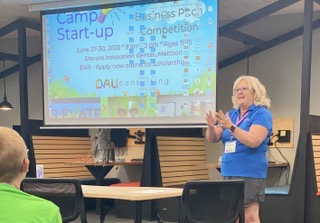
Founder Jeanne Dau introduces a business pitch competition.
Jeanne Dau, founder of Dau Consulting, has a background in business and communications. She worked in the hotel industry before coaching adults and non-profits in strategic planning and entrepreneurship education. Jeanne sat on the board of three non-profits and established four businesses. Both Susan and Jeanne met through The Business Solutions Center at Eastern Illinois University where Jeanne was director. It was there that an entrepreneurship course for high school students was created. The initiative was begun by the EducationCommittee as part of the Effingham Chamber of Commerce’s Vision 2020 initiative.
Susan, who owns SCH Consulting, began her career as a special education teacher. She then received her Master of Administration degree, which gave her the ability to become one of the State of Illinois’ Special Needs Coordinators working with 32 school districts in east central Illinois. She later became the director of the consortium Eastern Illinois Education for Employment System and was responsible for high schools’ Health Occupation classes.
The teaming of Jeanne and Susan at Eastern Illinois University was a great match. Jeanne’s business background and Susan’s educational background helped in the creation of Creating Entrepreneurial Opportunities (CEO), formerly known as E-3.
Susan and fellow facilitator Craig Lindvahl co-wrote the curriculum for the class. From there, it took off.
Within a few years, Midland States Bank adopted the program helping other communities throughout Illinois and several other states facilitate business and education partnerships to provide high school students an opportunity to have the CEO experience.
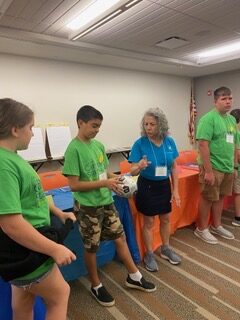
Camp Start-Up counselor Susan Hanfland helps campers think like an entrepreneur.
This is not a typical classroom course. Local businesses are the touchstone of the CEO program, which connects area high school juniors and seniors being taught by business owners, chief executive officers, bankers, and accountants while also touring businesses in the area and being matched with a mentor. Within the first week, students begin to create a class business, and those monies earned become the seed monies for individual or partnered enterprises during the second semester. The class culminates in a trade show highlighting student initiative.
But what about those middle schoolers?
Even before the first CEO class, Jeanne Dau was offering Camp Start-Up, an annual summer program where youth learn from local business owners and bankers about entrepreneurship.
Unlike CEO, those who participate only have 4 days to soak up all they can from those whose businesses have thrived and those whose businesses have dived. They learn about profits and losses. They learn about business loans. They learn how to write business plans. And most start their own businesses all in a few days.
The cost of camp is just shy of $190 but local businesses fund scholarships for those in need. As Susan said, “There’s a way; there’s always a way.” And with the knowledge gained, that money and more will be recouped if their start- ups are successful.
Beyond the nuts and bolts of learning about how to start and grow a business, be it in the summer program or in the credited high school class, students learn what Jeanne refers to a “basic adulting”—the importance of being on time, making eye contact, shaking hands, public speaking with poise, and writing a thank you note.
By the end of the summer camp, participants present their plans to the business community; and, there is a first, second, and third place winner chosen. This year, two ideas tied for first place and each participant received $50 seed monies to get their businesses started.
Annelea Weiler created Claws and Paws, a pet sitting business with the added benefit of her homemade dog treats while Liv Buehnerkemper’s venture was Babysitting Buddies, which is akin to Angie’s List for babysitting. The third place winners with a prize of $20 were Max Lombardi and Xander Schmidt who developed Shake It Up, a lemonade shake-up stand.
If you’ve ever been to a fair, these drinks are a big hit.
As you can guess, creating entrepreneurial opportunities for kids before they go off to college reaches even the most apathetic student. As a matter of fact, those most successful are usually the ones you wouldn’t expect. As Susan admitted, “Entrepreneurs are not the valedictorians.”
Those that create businesses are dreamers who don’t follow straight paths.
They color outside the lines. But it’s their passion that takes them to greater heights.
True, starting programs like CEO cost money. Thirty-thousand dollars, to be exact. But that cost covers the curriculum itself and the full-year salary of the facilitator who teaches half the day but spends the other half making connections to local businesses and finding mentors for students.
CEO was paid for by local businesspeople in Effingham who realized the benefits of having business savvy youth in the community, and there is an intentional shunning of CEO being inserted in public school curriculum. As Jeanne said, “People in Effingham wanted it independent of public schools.”
This says a great deal about the public’s distrust of the Illinois State Board of Education. Even though there is a state standard for consumer economics Susan said, “Districts are adept at watering things down.” And she’s right.
In Chicago, CPS and the CTU have been doing Chicago’s children a disservice for decades.
Graduating with an inability to read, complete math problems, and write well are hinderances to future employment. Thus, independent programs like CEO and Camp Start-Up would be assets, especially in depressed neighborhoods. The earlier we can get kids involved in understanding basic banking, consumerism, and entrepreneurship the better.
Though CPS’s budget of $9.4 billon could certainly afford CEO or Camp Start-Up programs, the avoidance of bureaucracy and Chicago politics is necessary. The only way to facilitate the growth of these programs is to rely on the generosity of Chicago businesses and business leaders who will foster youth. Honestly, it is in their best interest to do so.
No bureaucracy ever built a business. People build businesses out of a dream. They build businesses from hope.
Furthermore, there is no coddling of participants, which is made clear to parents during orientation. No absences. No tardiness. Come prepared and ready to learn or you’re fired.
These programs teach what it’s going to take to be successful, whether kids and teens create businesses or not.
We need to raise the bar if we plan on having the next generation of doers. Though it is mystifying that our public education system no longer provides high standards for students, it is gratifying to see that there are those like Jeanne and Susan who have blazed new trails.
They still have dreams for that next generation. They still have hope.
-30-
 Erin Geary is a writer, consultant, mother, wife, and volunteer. After thirty years of teaching, she left the profession to pursue her dream of writing. Her twice weekly articles on American culture and politics can be found at Commonfolk365.substack.com. She recently celebrated her first year writing and is thrilled to be a guest writer for John Kass.
Comments 34
“No bureaucracy ever built a business.”
Please re-set the type on that sentence and make it ALL CAPS AND BOLD FACE.
A perfect statement.
My grandfather taught engineering in a college in Peru. Back when he taught there were two distinct classes, upper and lower. If he saw a student from the poorer class that showed promise he gave him seed money to start a business! Several became millionaires. The power of a GOOD education is priceless. What children get today is indoctrination. We MUST go back to basics and hold children accountable and not just “socially “ pass them so their egos aren’t hurt.
No coddling. Love it.
Would like to have a name to contact to see if we could make a donation to one of the affiliated programs referenced in your post.
Grew up on the south side of Chicago and schooled and then taught in Graduate school at UofI in Champaign Urbana.
Learned more from the farmer friends I met from Mattoon, Pekin, Danville and Harrisburg than I ever did from any professors in chemistry.
ssarovich@sardee.com
Jeanne is the go-to for Camp Start-Up. Google her Dau Consulting site.
What H Young said
NO BUREAUCRACY EVER BUILT A BUSINESS
Erin Geary notes, “ ‘Entrepreneurs are not the valedictorians.’
Those that create businesses are dreamers who don’t follow straight paths.
They color outside the lines. But it’s their passion that takes them to greater heights.”
In my 46 years of classroom teaching, it was a common fact that the strivers were the ones who had to re-write their papers, over and over. One young man, Sergei Ganz, learned three languages on his own hook, applied for and was accepted at a university in Spain, where he started up a website site dedicated to culture, he is the CEO of The Avant Guard Media. Sergei was not one those ‘honored’ at his graduation.
Great and important essay, Erin Geary!
https://drivinginnovation.ie.edu/ie-university-students-launch-critical-thinking-and-sustainability-platform/
So Pat are you implying that “merit and excellence” play no critical role in our society nor in personal success … that the “wokesters” who now denigrate and mock such concepts are correct to do so?
Excellent essay!
“No bureaucracy ever built a business” perhaps Sen. Elizabeth Warren should learn from this…
Your essay hits true on so many levels. But the big one to me is the no coddling. You set expectations and standards and adhere to them the kids get it and will rise to the occasion. Once you instill the ethic of hard work and dedication you get kids that are achievers; not at all the same level, but achievers none the less.
Also I love the critical thinking. I was at my son’s graduation at St. Olaf in Minnesota. The Provost said something at the ceremony like “what is the price of critical thinking” alluding that going to college like St. Olaf makes you a critical thinker and the cost of tuition is valid. Not so. Just take a look at all those farm kids that can reverse engineer or repair a part in the field while harvesting and do it before they are 16 years old.
Love this article. The quote of “no bureaucracy ever created a business” is wisdom and truth at its best.
Our youngest daughter enrolled in an Entrepreneurship course at Ohio State. I said to her at the time that I regretted not having access to a course like that when I was in college.
How naive of me. I followed along with her on her course. Soviet-style central planning. The teacher had NEVER been in any kind of business, let alone a start up. She knew nothing about business and that course was a colossal waste of time. How can a B1G university have a teacher who was that un-prepared to teach the subject matter. Makes you wonder what else you might discover to be so lacking.
Thank God for true entrepreneurs who are generous with their time and wisdom to actually teach.
Elites have hijacked education, media, entertainment. They look down on those who work with their hands, and especially those who break a sweat while working.
Education has been watered down and instead of pushing knowledge and critical thinking, there push feelings and a liberal social agenda. So much of the school day is wasted and the students spend little tie working, studying, concentrating. Many actually play video games of me sort or another much of the day on tablets that are not monitored by and overworked, unsupported staff. Academic rigor, achievement, and hard work are not valued. It’s “kindness”, “tolerance”, and “equity”.
The only solution is school choice as far as I can see. The unions and the leftists have hijacked public eduction so that it is a jobs program and a social indoctrination entity more than teaching reading and mathematics.
And the “black and brown”, the poor, those who democrats love and care about so much, suffer them most. Trapped in dropout factories where few can read and write near grade level, there are no jobs, no adult role models, and everyone waits for the government check to arrive.
These people also receive sub standard health care, suffered the most during Covid, paid the highest price during the financial crisis as well.
A few thoughts…
My husband and I came to farming late in life, but we’ve always been “make-doers” so the transition wasn’t too difficult. It’s a good life, a hard life, and a life that challenges us every step of the way.
Camp Start Up reminds me of Junior Achievement, but much better, more practical and personal.
Many adults can use this kind of course as well, as side-gigs are becoming the norm.
Great article, Erin. Thanks a bunch!
Excellent article. And so so true.
Great article! I hope this initiative continues to grow.
Brilliant concept. An even more brilliant concept is keeping it a privately funded, non governmental entity. Teachers unions contaminate everything with their political agenda. They would destroy any concept of self reliance and invention with socialist politics, sexual orientation politics and the new buzzword for scamming public money “a non- profit”. Yes, the “non profit”: as defined: People dumb enough to work for free or intern for little salary get the “non” part. They are usually young college educated idealists who live in shoddy apartments with two or three roommates. Highly salaried, richly compensated executives get the “profit” part. They usually drive Lexus/ Mercedes cars and live in luxury condos on Lake Shore drive. Yes, the taxpayers usually pay for this as these “nonprofits” are usually taxpayer funded. Mayor Brandon(Is Better) Johnson is currently directing Chicago taxpayer monies to these entities to mask the siphoning of public funds now being paid to his political cronies. The people running the “non profit” usually scam money until the feds start snooping around forcing them to fold and start a new “non profit” when the heat dies down. Repeat the process. Get paid. “Violence Interrupters” seem to be a very profitable “non profit” these days. At least in Chicago…
“Elitists believe they lack the intellect or higher education of their coastal brothers..” No, they don’t. It’s a tired cliché and right wing trope manufactured to divide, your article could have begun with “Farmers live remotely..” and been far more informative, and reach a wider audience outside the echo chamber. If I started off an article about a successful inner city educational program (there are many..) with “MAGA diehards and right wing sycophants believe coastal blue cities are dying cesspools of unchecked violence and corruption..” I’d lose half my audience, wouldn’t I? Pick your cliché. FYI the population of Effingham is 12k, population of Chicago is 2.7 Million. You do realize that makes a difference, right? Not to whitewash the failures of the CPS, but I’m not certain a rural community downstate is a fair comp.
Yet, all you can do is self-gratify. Empty words from the resident Onanist. Like Trampas in Owen Wister’s “The Virginian,” you will remain a pusillanimous pest to your mortal end.
Bullseye!
(And humorous.)
Obscure literary reference and gratuitous use of seldom uttered 4 syllable words-check. False intellect has become a tenet of the new, subversive, exclusionary far-right, I see it everywhere. Everyone wants to SOUND smart, being smart is a whole other matter. I digress-I liked the program outlined here in the article, I just didn’t think the trope set up was necessary. Here is a big word for you Pat Hickey-it’s Sesquipedalian. Look it up, sounds familiar, right??
I’m confused why you read John Kass News if you have such vehement hatred for its content.
Totally fair point. There are very few ‘Chicago-centric’ voices left in local journalism brave enough to write unflinchingly about the challenges facing our city, but whose genuine affection for Chicago still shines through the words. John used to be one. Then vanity overcame him and he tossed his voice into the MAGA cauldron of SOROS bogeymen, Trump apologists, all things ‘woke’ (a convenient bit of word salad used to deflect one’s own bigotry..) and Christian nationalism. Maybe he felt it would garner him a wider audience and more national credibility, it didn’t, and his voice is becoming fainter. I miss the old John, I genuinely do. Even when I disagreed there was always a kernel of truth in his words that reflected a journalist who has seen the underside of how the city Werks (intentional misspelling..) Now it’s as if the comment section on Newsmax has come alive spewing the same red meat vitriol and crusty old guest writer cranks who bemoan a ‘failing’ American youth, and pine for a long ago when the moral and ideological North Star was a soda cracker white Christian who was given respect based on they’re birthright. I guess I’m here because I miss old John, and for the record, his Greek Chicken recipe has become a summer staple, although he uses to much garlic and I add fresh dill.
I think you are confused. By your own reasoning you should be gone … you admit you got what you wanted. According to you, the “old John” whom “you miss” is long gone … reading and commenting on the “new John’s” column will not bring the “old John” back. Unless of course you think you are on a mission from God to convert the “new John and his heretic disciples” into the “old John”. You already got his chicken recipe which you altered to your liking … so again in reference to Ms. Geary’s query “why are you still here?”
Again, fair point. I believe puncturing the echo chamber with alternate but informed opinions is a noble cause, I really do. This may come as a shock, but I am a reformed Republican, who feels as though the party abandoned me when it embraced Trumpism, hypocrisy, the culture wars and white supremacy. If Chris Christie won the nomination, he would be President in 2024, guaranteed. Instead, bitter old cranks like you want to drag the country backwards into whatever idealized version of America existed ‘then’ as if you have any idea what it’s like to be born into a post internet world. You have no clue. I’m just here to remind you. You’re welcome Bruce!
Love your sentiment and word choices!
I think what “Riga Tony means to say, translated into Chicago-ese, a language only those from Chicago speak is “I am a true NITWIT”. Tony, being a billionaire real estate skyscraper mogul headquartered in Beloit Wisconsin would not know this since he is not from Chicago. Or even a real person for that matter. A fictional nitwit is a nitwit, imaginary or real. Same bullshit. Same shithead. No difference.
Remember that Riga-Tony is Tony Cesare. This is a man who literally tried to commandeer another person’s identity by claiming on his own FB page that he – Tony Cesare – was the proprietor, bartender, cook and bouncer of Tony’s Tap in Mineral Point WI. In fact he was no such thing. Yes there is a Tony’s Tap in Mineral Point WI, but it is not owned by Tony Cesare. In fact no one up there ever heard of Tony Cesare. So ask yourself this: what type of person does this sort of thing? To add to Tony’s illustrious BSing, when commenting on John’s prior site formatted via FB, Tony said that if he ever had to pay for a subscription to JohnKassNews he would never ever do so, because Kass and his “acolytes” were not worth his time. Yet here he is … ole Tony Cesare, paying and commenting away, as if he can’t help himself. Also note Tony was proud of the fact, that prior to John’s revision of his site, he could access and comment free. He had no qualms in doing so. So when anyone reads any of Tony’s comments just remember the type of person who is writing those comments.
I’ve mentioned it often but I’ll repeat again, the Tap is where its always been, on the muddy shores of Lake Pearling just east of downtown Kleintown. Stop in anytime Bruce, your first ‘Goniff’ (Mania liquor, 7Up and Grenadine) is on the house!
FYI My friends call my Anthony, would you like to be my friend Bruce? I consider you a friend, I mean anyone who thinks about me as often as you do must be a friend! C’mon! We can hang out! Drink beers at the local Moose lodge-play Golden Tee, do you play?? I’m pretty good! You can regurgitate MAGA talk points and enthrall me with tales of ‘woke’ things, who knows, maybe you can convert this Libertarian into a bitter old crank who bemoans an entire generation he knows nothing about. It will be fun! I’ll buy…
I don’t believe ‘nit-wit’ is a Chicago-centric insult. Now ‘jag-off’, THAT’S pure Chicago!
” Jagoff” is Chicago-centric and fitting, but do read up on the dangers of that most solitary past-time.
Go to the classics in all things.
https://www.gutenberg.org/files/54713/54713-h/54713-h.htm
Okay, so shall I refer to him as “Tony Bologna” from here on out? I do like to hear opposing opinions like it was in the old days and I’m sure John agrees. Obviously, I agree with John. I took the Trib subscription $$$, canceled it, and put it into the reason I bought the paper in the 1st place!
Yes, I thought we got this fool to leave the site but like a bad case of the crabs, he keeps coming back! Feel free to ridicule and refute the inane opinions he/she/it ( preferred pronouns) spouts. A true glutton for abuse, I guess…
Well Enrique we actually accomplished something. We finally got Tony the Phony Baloney to admit why he is here: he is on a mission from God to penetrate and puncture all “echo” chambers which offend his beliefs. He is a true beleiver. Yes, Tony has been appointed by the Lord High Poobah of Wokeistan to invade and defeat all who reside in Kassian-like “echo” chambers. That is – as Tony admits – his life mission. He is on a righteous crusade. He is a missionary from Wokeistan. He just can not help himself.
This looks promising. Thank you
A leftist troll with an extended vocabulary is still just a troll, folks. Stop feeding them.