


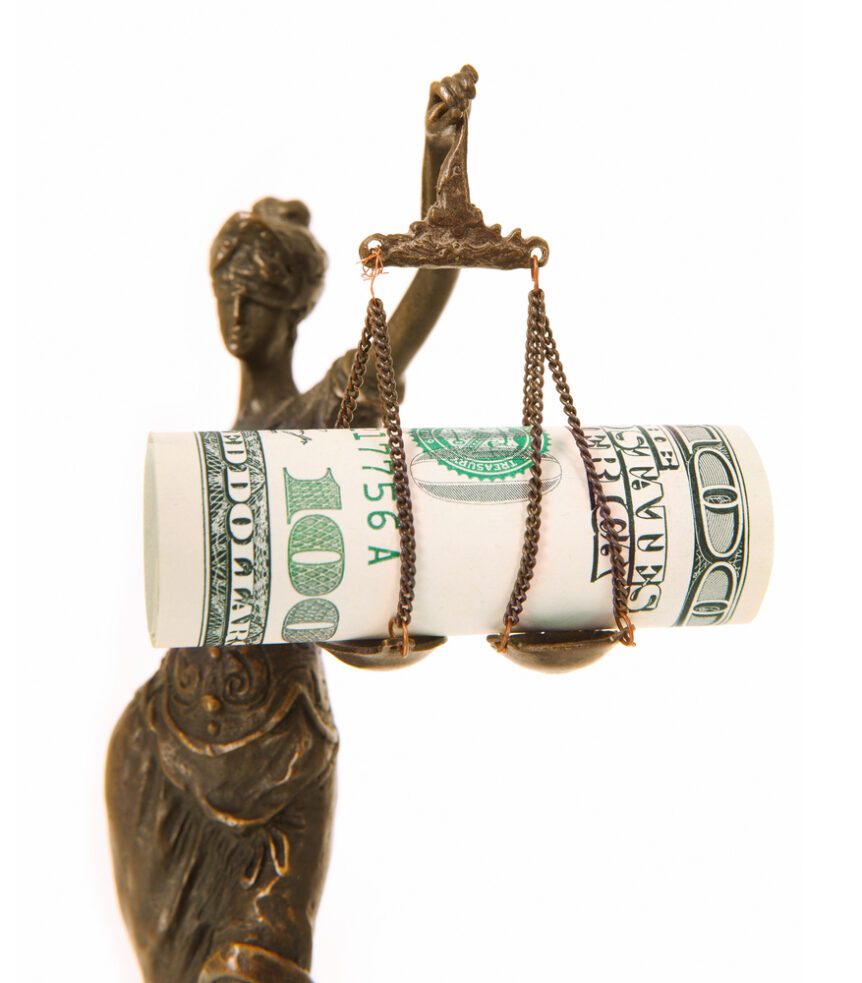
Chicago’s Criminal Industrial Complex Meets Its First Real Check
By Paul Vallas
March 20th, 2026
Chicago has spent years paying hundreds of millions of dollars in wrongful-conviction civil settlements. Now, for the first time in a decade, the system that produced those payouts is facing real resistance in Cook County State’s Attorney Eileen O’Neal Burke and the reaction has been swift. Last week, a prominent Chicago civil-rights law firm publicly urged the appointment of a special prosecutor to prevent Burke from prosecuting misconduct by federal immigration agents during “Operation Midway Blitz.”
That request, ostensibly a narrow dispute about federal immigration enforcement, actually reflects something much larger: a struggle over the future of Chicago’s sprawling conviction-reversal apparatus and the enormous civil litigation industry that follows in its wake.
For roughly a quarter-century, Chicago has been the national epicenter of wrongful-conviction litigation. When decades-old convictions are vacated, ensuing civil-rights lawsuits against the city routinely end in multi-million-dollar taxpayer-funded settlements, collectively approaching/exceeding a billion dollars.
For the private lawyers who specialize in bringing these cases, the incentives are all-to obvious. Successful lawsuits generate enormous contingency-fee recoveries, typically 33 to 45%. The faster convictions are overturned, the faster the civil litigation begins. But the gravy train leans heavily on one critical step: a prosecutor willing to concede that a conviction was wrongful. When that happens, the legal pathway to civil liability becomes dramatically easier. That is why the posture of the elected State’s Attorney matters so much.
The Shift That Changed Everything
From 2008- 2016, Cook County State’s Attorney Anita Alvarez took a discerning approach to post-conviction petitions. She agreed to vacate convictions when petitions were supported by the evidence but frequently challenged post-conviction petitions when that wasn’t the case. Ultimately, it was Alvarez’s willingness to take on Northwestern University’s Medill Innocence project, whose outrageous tactics in seeking to free guilty felons led to the resignation of its leader, Professor David Protess, that made her a political target of reversed-conviction advocates who trumpeted that prosecutors were standing in the way of justice.
Alvarez’s successor, Kim Foxx, ushered in a dramatically different era that plagued the city from 2016-2024. During Foxx’s tenure, the pace of vacated conviction multiplied dramatically, spawning a tsunami of civil lawsuits against the city. Well over 200 wrongful-conviction suits were filed as a result, exposing City taxpayers to billions of dollars in potential liability. Ultimately, Foxx’s troubled tenure collapsed amid multiple controversies, most famously the Jussie Smollett debacle. By 2024, Cook County voters were ready for a change.
A Different Kind of Prosecutor
That change came with the election of Eileen O’Neill Burke, who had impressively served Chicago for over 30 years as a prosecutor, a criminal defense attorney, a circuit court judge and an Appellate Court justice—where she was widely regarded as a careful and methodical jurist—before seeking to restore confidence in the State’s Attorney’s Office by seeking election to the County’s top prosecutor job in 2024. Her campaign promise was straightforward: post-conviction petitions would receive serious scrutiny before decades-old jury verdicts were overturned. Claims of innocence would be examined carefully rather than accepted reflexively.
Since taking office, Burke has been true to her word, slowing—but not stopping—the pace of conviction reversals. Petitions now receive much deeper review. Prosecutors are again testing claims in court rather than conceding them outright. For those whose careers depend on Chicago’s conviction-reversal pipeline, that change represents a serious threat.
Enter the Special Prosecutor Demand
Viewed against that backdrop, the call to remove Burke from decisions involving ICE investigations looks less like a narrow legal dispute and more like a strategic escalation. The argument advanced by her critics is strikingly thin. Burke has established protocols—adopted not just by her office but by every Illinois prosecutors’ office including Attorney General Kwame Raoul—directing local enforcement to document, collect, and forward to her attention evidence of excessive force by federal immigration agents, after which she will initiate criminal prosecutions where warranted.
This is eminently reasonable, and what should be expected of an elected prosecutor who carries the enormous responsibility of deciding who should and should not be tried with serious criminal offenses. Such a protocol hardly creates a legal conflict of interest. It is not misconduct. And it certainly is not a basis for courts to strip an elected prosecutor of authority over criminal investigations.
Yet that is exactly what the petition seeks. If granted, the precedent would be extraordinary. It would mean private lawyers dissatisfied with the pace of a criminal investigation could ask courts to remove an elected prosecutor and install someone more aligned with their preferences. In most jurisdictions, such a request would stall at the starting gate. Courts traditionally guard prosecutorial discretion closely, intervening only where genuine conflicts or ethical violations exist. A disagreement over investigative protocols simply and obviously falls well short of that standard.
Why This Fight Matters
The stakes extend far beyond ICE investigations. For years, Chicago has operated a legal ecosystem in which one outcome produces another. Convictions are vacated. Civil suits follow. The city is forced to hire expensive law firms to defend the cases. Multi-million-dollar settlements are paid. Private attorneys grow richer and richer. Meanwhile, the City’s financial condition continues to take one massive hit after another.
Chicago already faces major structural budget deficits; pension obligations are at $46 billion and the city’s tax burden is among the highest in the nation.
Every new wrongful-conviction settlement adds yet another obligation to taxpayers who had nothing to do with the underlying cases. That reality has forced a growing number of residents to ask an uncomfortable question: is the system still calibrated to pursue truth—or does it simply reward volume? A prosecutor insisting on careful review disrupts that model. And disruption provokes resistance.
Chicago’s Unpredictable Courts
Under ordinary legal principles, the effort to sideline Burke would clearly fail. The law governing special prosecutors was never intended to allow private litigants to override the discretion of elected prosecutors simply because they disagree with the prosecutor’s protocols. But Chicago has never been a typical legal environment. The city’s political and legal networks are famously intertwined. Judicial elections, political alliances, and high-stakes litigation often intersect in ways that blur the boundaries between law and politics. That makes the outcome more difficult to predict than ought to be the case.
What is clear, however, is that this fight represents something much larger than an immigration-enforcement investigation. It is, rather, an important battle in the war over whether Chicago’s conviction-reversal industry will continue operating at the breakneck pace of the past decade—or whether, for the first time in years, a prosecutor’s insistence on careful scrutiny will slow the machine down. Make no mistake, the criminal industrial complex is not merely focused on ICE cases: it wants to discredit and remove Burke from office.
The question, it seems, is whether the courts will see through the masquerade and dismiss the petition. Chicago taxpayers have much too much riding on the answer.
-30-
 Paul Vallas formerly ran the public school systems in Chicago, Philadelphia and the Louisiana Recovery School District. He was a candidate for Mayor of Chicago.
Comments 18
I’m shocked! Shocked, I tell you, that political fraud and graft have been going on in the City of Chicago!
Thanks Paul, for being a beacon of truth.
truth tellers can’t get elected in corrupt places like Chicago
Mr. Vallas
Excellent. The Public has no idea.
Eileen O’Neill Burke.
Speaking of vacating, I’m on the count down to vacate the graft, corruption, ineptitude, stupidity, etc. of IL/Cook/Chicago to another state where politicians work (more) for their citizens rather than themselves.
I like and am optimistic about Burke but I don’t have a generation of time to see what good results she can drive, assuming she doesn’t get railroaded as laid out here. Life is too short.
Very well said. At the time, we had two children to raise. I see now, that the city has passed a 20% hotel room tax.
More incentive to stay in the suburbs.
My heartfelt condolences to the family and friends of the devout Catholic freshman Sheridan Gorman Loyola University student from New York state who was innocently gunned down on the lakefront in Rogers Park by Loyola. I used to live at that very location years ago and you could go to the lakefront at anytime of the day or night without any fear. A New York friend of the victim stated that he heard this was one of the safest areas in Chicago…..there is no safe places in Chicago. I am sure the mutt that pulled the trigger is a red-haired, freckle face, Irish honor student, as much as I am sure our mayor will speak out….oh wait, the victim is white.
Brings up the point that the judge who let the 49 arrested 13.2% dude loose again, so he could set an innocent woman on fire on the L. She needs to go away for the rest of her worthless life.
Bravo, Paul Vallas and Eileen O’Neill Burke!
These civil settlements are out of control and each one needs to be thoroughly investigated.
And all payouts should be capped at five million dollars – or less.
Only after the shyster is disemboweled.
Josef Medill, the gift that keeps giving. Can we please lose this guy once and for all
This is the most eye-opening column I have read anywhere. I never understood why the sudden volume of budget crushing settlements involving the CPD. Now I know. Thank you, Paul Vallas, for enlightening me, and I suspect many, many more about what’s going on in the Crook County courts. Pardon me if my cynicism leads me to a pessimistic expectation of how this battle will turn out.
Oh God, why weren’t you elected mayor?!? What a shame. You could have saved the city.
Only one reason he wasn’t. He’s the wrong color.
It’s such a shame to see a once great city being eaten away by the lawyerly class parasites and the crime increasing by the thug class.
Thank you Paul, for explaining this and further exploring the rot that exists.It never stops, does it? Also, I notice that it isn’t just “welfare roaches” and illegals as some of the right wing barkers like to rail about.
We careen from crisis to crisis, but the big one is financial. When the money run out, when the credit is used up, when we’re sold everything we can, then the suffering will really start.
Kass said they bribe the people with their own money. But I think they also bribe the people with other people’s money.
Local, national, and world, we see a Sodom and Gomorrah come to life in real time. A veritable Tower of Babel. Only those who proclaim to be working for God, are actually working, working for themselves.
About time a voice of reason speaks on this issue. Great job Paul. This longstanding and ongoing political corruption could bankrupt the city and county faster than their well documented pension corruption. Chicago and Crook county being what they are, it’s only natural the local attorneys would try to negate reform. Is anyone shocked?
Thanks AGAIN Paul. A certain minority who’s managed to destroy the south and west sides, historically have never met a way to screw the taxpayer. When they gain power, things like this always happen.
One of the many reasons we moved to Orland, and then, in the eighties, out of the criminal enterprise called the state of Illinois.