


A Day in the City
By Nicholas S. Kass
May 9th, 2025
Long ago, a young man made his way through the streets of the City, weaving into the throng, sidestepping the touts, beggars and pickpockets along the way.
He moved past the vendors blaring folk and modern pop music in several local languages from their pushcarts.
He heard the call to prayer sounding out simultaneously from many different mosques, grand and humble alike. The voices emanating from loudspeakers attached to minarets seemingly tried to outdo each other in their skill and praise of God Almighty.
He saw many men, young and old, entering the mosques to pray. Many others by necessity or choice kept up the busy pace of their lives, under the pressures and enticements of the world.
In the mosques, he noticed tourists walking about dressed for a day of sight seeing, oblivious to the customs and requirements of piety and decorum. Some, wearing the short pants favored in the West, were provided blankets and gently instructed to wrap the lower parts of their body.
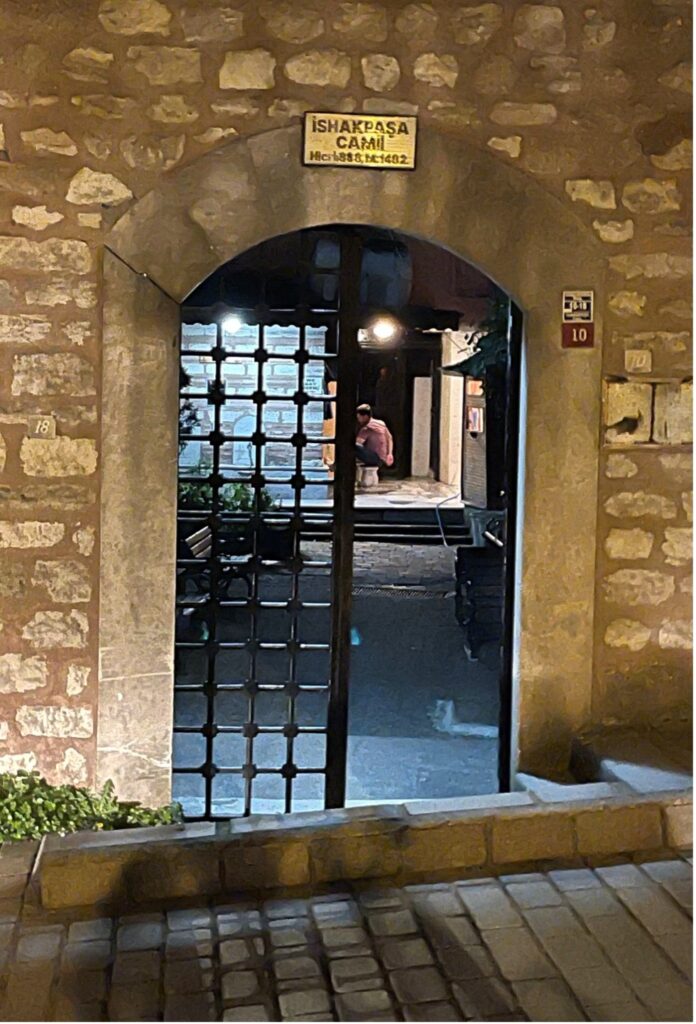
Ishak Pasa Mosque, Faith, Istanbul
He wandered down the road to an old neighborhood. He heard another sound, of rhythmic chanting clear as freshly polished glass. He could feel the vibrations of the sustained drone notes that anchored the melody. They came from an ancient church building, far older than the country of his birth, with choirs of cantors on different sides in front of the grand iconostasis. They, too, glorified God and asked for His blessings and forgiveness for all.
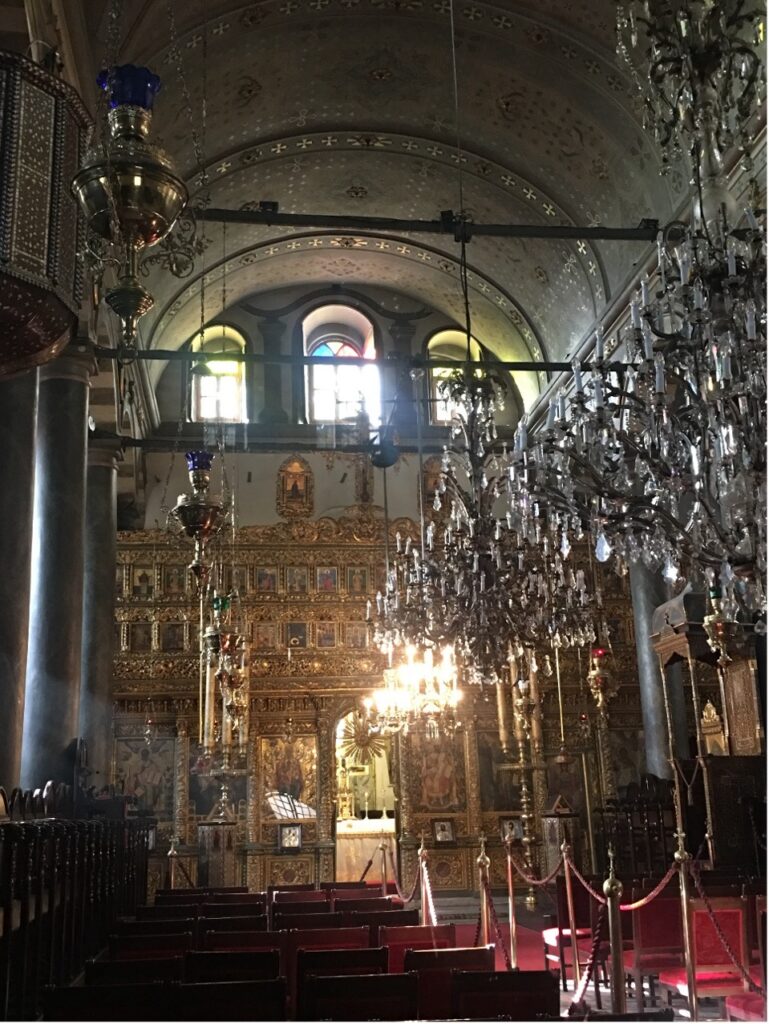
Patriarchal Church of St. George, the Phanar, Istanbul
He lit a candle and kissed the icons, walked through the church, stopping to pray before the relics. The church was virtually empty save for the cantors and the priest. He thought of the days not too long before when it and other churches would have been filled to bursting.
Nevertheless, the church compound, surrounded by walls and with one gate permanently closed as a reminder of the martyrdom that occurred there long ago, endured both as a refuge and a rebuke to the illusions modern life. It was also a reminder of the truth that stands, despite of the world’s indifference and ignorance.
He kissed the icons again, and walked out into the sun.
Crossing a long bridge, he watched a dancing bear wearing a fez and hopping on its hind legs toward him, restrained only by a thin leash in the hands of the street entertainer who guided him along. None of the other pedestrians seemed to notice.
In the afternoon heat he took refuge in an ancient tea garden, sitting with his back against a cool stone wall in the shade of the trees, their branches extending in a canopy over the courtyard. A fountain trickled nearby.
His presence attracted the attention and hospitality of the regulars. Soon, they were seated with him, the smoke from their cigarettes turning the air above them blue as they drank tea, clicked their beaded tesbihs and eagerly discussed the news of the day.
The locals wore the fedoras, Greek fishermen’s hats, and the soft, brimless caps that had come to symbolize center-right, center-left and religious conservative sensibilities. They argued their positions vigorously but carefully, so as not to offend each other in front of their new guest. They searched his face for his reaction whenever they thought the peace among them had been on the verge of a breakdown.
In the evening through an open doorway he heard faint snatches of a wailing melody competing for his attention with the sounds from the street.Curious, he followed the music down a staircase.
Another door. He pushed it open and walked in.
His eyes adjusted to the darkness. He made out small tables. At some, men and women were seated together. At the others men sat drinking slowly, alone.
He could smell charcoal burning slowly in a brass brazier near the back room.
The patrons sat still. No one spoke.
He moved to an open table and sat down. A few feet in front of him on a low stage a group of musicians were at work.
A man on the cümbüş was singing, hissing sharply and interjecting through the gap where his front teeth once were, his fingers flying across the fretless neck of his instrument. The men on the qanun, the kemence, and the bendir were stonefaced, revealing themselves only through their playing, improvising while keeping the complex rhythms the young man had known since his early childhood.
A young woman with downcast eyes danced as she approached him, gently swaying her hips to the music. An old woman close behind her thrust a tambourine in his face like a collection plate, shaking it under his eyes.
He waved them away.He ordered rakı and a water pipe and let the music take over.
He recalled things he had read and heard about the old days, how musicians would come to the City from every community in the Empire, singing in different languages of their shared experiences and pain, reveling in their virtuosity, learning from each other, blending what they learned.
Most of that world had disappeared long before that day long ago, when he was walking the streets of the City.
But occasionally there were reminders, clues in the music, in the signs carved in stone on the facades of the old buildings that lined the streets, in the old mosques, churches, and synagogues, in the ancient ruins, in the cuisine, and in the silent and vast cemeteries.
And in that tiny living remnant of an earlier time, the musicians and patrons were waiting like a herd of ibex perched on a sheer face of a snowy cliff, with nowhere else to go.
-30-
Nicholas Spyridon Kass is Senior Fellow for European Affairs at the Center for the National Interest. He served in the U.S. Government for 31 years, retiring on January 20, 2021. Most recently he was Deputy Assistant Secretary of State, Director for European Affairs (twice) and Director for Intelligence Programs at the White House/National Security Council, and Deputy National Intelligence Officer for Europe at the National Intelligence Council. A Turkish and Kurdish speaker, for many years he was at the U.S. Embassy in Ankara, Turkey. He also served at the Central Intelligence Agency, including as Intelligence Briefer to the Director of Central Intelligence, and was awarded for unique contributions to the CIA HUMINT mission. Now in the private sector, he is Executive Director for International Corporate Affairs at the Nawaf Salameh Family Office, headquartered near Bucharest, Romania. He can be found on X (Twitter) and LinkedIn.
Comments 13
From my rearview mirror 0f my car I have the two rosaries of my special needs daughter dangling. Tucked in the corner of the front windshield is a small placard proclaiming, “Pray the Rosary.” Remnants of my ancient faith that helps sustain me. When I drive and my mind wanders and I begin to have negative thoughts about a person or institution, I ask God to give that person all that I desire for myself, and the devil disappears. Thank you for the wonderful column and for your service.
Good morning John. The Devil is everywhere and there are people that want America to be a Muslin Nation. They are in the Congress of the US. Trust the Lord he will set things straight when be comes from the sky and he will come sooner than people realize.
Xristos Anesti John.
Mr. Kass- This was really very well done. I had the privilege of traveling internationally and teaching for the State Dept and Defense Dept, and your descriptions of the street scenes really brought back some memories. I loved to travel and believe that it makes you a more well-rounded person and gives you a much better appreciation for what we have here. There are a lot of really good people out there, and if you are looking for them, that is what you will usually find.
I can see that you are a lot like your brother, and you are also making your Greek ancestors proud.
I too had the privilege of international travel. My most memorable and best learning “day in the city” was East Berlin shortly after high school. My group and I met Russian soldiers on leave in a youth hostel, broke bread with them, and sang Beatles songs. We were all bright eyed and relatively innocent youth who shared the best cultural exchange I’ve ever had. Even though it was the cold war, I saw myself in them.
I 100% agree with “There are a lot of really good people out there, and if you are looking for them, that is what you will usually find.” The most rewarding way to lead one’s life.
Beautiful and poetic, brings my travels through Lebanon and Jordan to mind. I also came away with a completely new appreciation for the people of the region. Honestly, I felt safer there than anywhere in Chicago.
Vivid imagery. Can almost smell the body odor and kabob. Michener-like. Well done Nick
Spot on Ed ! Mitchner captured all the assaults on the senses.
Great work, Mr. Kass!
Mr. Kass, a lovely piece of writing. It reminded me of a trip to Istanbul 2 years ago.
Well written – paints a picture with words. One can feel he is there with the writer. Thanks!
Nick this piece reminds me that you have at least one and maybe two good books that you could share with us the readers. I’m always left with wanting to know the rest of the story
Mr. Kass:
What a vivid depiction of this city! I am assuming it is somewhere is Turkey but the portrait you painted made me feel like I had been there. Thank you for your contribution to a wonderful Friday.
I love how you painted a picture with words of a cross between the horror that Billy discovered right before his imprisonment in a Turkish prison for smuggling drugs (in Ankara I believe) from 1978’s “Midnight Express” and the Erie mystery of minarets during the call to prayer! I’m guessing this is a Turkish city!