


National debt warnings are getting louder. Will we listen?
By Greg Ganske,
June 26th,2026
What do the U.S. Government Accountability Office (GAO), the Congressional Budget Office (CBO), the Committee for a Responsible Federal Budget (CRFB), the National Taxpayers Union, the Peter G. Peterson Foundation, the conservative Cato Institute and Heritage Foundation, the liberal Manhattan Institute and Brookings Institution, financial and markets analysts J.P. Morgan Private Bank and the Federal Reserve system all have in common?
They all warn us of the dangers of our burgeoning national debt.
They all must feel like the Trojan prophetess Cassandra who was cursed to foresee future disasters and to have her predictions ignored and dismissed. Cassandra was the most beautiful daughter of King Priam and Queen Hecuba of Troy. Smitten by her beauty, the god Apollo offered her the power of prophecy in exchange for her romantic favors.
She accepted the gift but refused Apollo’s advances. So, he spat into her mouth, ordaining that no one would ever believe her words. For instance, she predicted a catastrophic war over Helen and was dismissed. She warned of armed warriors inside the massive wooden horse the Greeks left outside Troy’s gates and was ignored.
All these respected organizations from diverse viewpoints warn of the danger of the rising national debt. As the national debt surpasses $39 trillion, these organizations repeatedly publish research, issue warnings, and propose fiscal metrics to address the long-term unsustainability of our current course and eventual disaster. To mix metaphors with the Bible, they must feel like Cassandra crying in the wilderness. This year alone the Treasury Department is projecting a budget deficit of at least $2 trillion, up to $300 billion just since February.
In 1995, when I went to Congress, the national debt was $4.45 trillion. Over the next four years of spending restraint, Congress and President Bill Clinton reduced the public held debt by approximately $400 billion, the only time since World War II that this part of the debt was actually reduced. The gross debt did increase in this period if one counts the Treasury borrowing off-budget surpluses from government trust funds like Social Security.
The debt-to-GDP ratio has increased in the past 30 years, from 46% to 120%; the average debt per household has risen from $52,000 to $289,000. It is not rocket science: The key drivers of the increase in debt is government spending outstripping tax revenues, especially driven by mandatory spending in programs like Social Security, Medicare, and Medicaid. There were also severe spikes in crisis spending during the 2008 Great Recession and the 2020 COVID-19 pandemic response, which alone added $4.5 trillion in a single year.
This debt is not without cost. The U.S government now pays roughly $3 billion a day just to service the interest on the national debt. This makes interest payments on the debt one of the biggest segments of federal spending. Total interest payments are now over $1 trillion annually, surpassing federal spending on both national defense and Medicare. Foreign investors hold about 30% of total public held debt meaning these payments are not available for investment in this country.
What does this mean to the average citizen and for the government?
The rising net interest costs create a “debt doom loop” where the government borrows just to pay the interest on previous debt. The trillions spent on interest divert tax dollars away from crucial infrastructure, healthcare, education, and research.
Increased government borrowing consumes a higher percentage of available savings, leaving less for private enterprises. Less capital means businesses invest less in newer technologies, factories, and equipment. With lower productivity, paychecks stagnate. Higher interest rates make it harder to buy a home and everyday goods become more expensive. If there are future crises, a country’s capacity to borrow is reduced.
The big fear is that if the debt becomes too high, international investors could lose confidence in the bonds, which then forces spikes in higher interest rates with a vicious upward spiral until the bond market collapses. The central bank faces political pressure to monetize the debt by printing more money. This erodes trust in the dollar and devalues the currency. (Even without this type of crash, it takes $40 in today’s dollars to buy what $1 did in 1900.)
In 1995 through 2000, the budget was balanced when we lowered spending by shaving about 1% off an increase in spending and we had a good economy. To address the current deficit and stabilize the national debt, we will need the same spending discipline and also to increase tax revenue. Raising taxes is as popular as pulling teeth, and reducing the rate of growth of spending is equally unpopular.
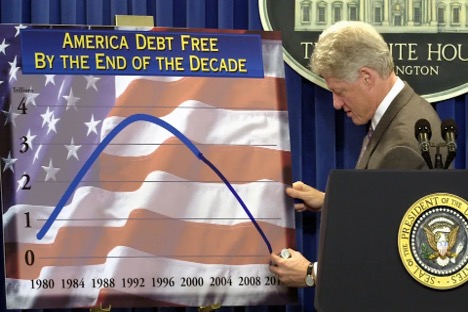
President Bill Clinton uses a marker to extend a graph of the current paydowns on the national debt to illustrate that the debt could be eliminated by the year 2010 during a briefing at the White House, on Dec. 28, 2000.
However, without a combination of spending restraint and increased revenue, the warnings by the organizations cited previously will continue to be ignored like Cassandra’s. The options for increasing revenue include expanding payroll taxes, income surtaxes, and reforming corporate tax rates, among others.
Reducing mandatory spending will be necessary. Over 60% of federal spending goes toward mandatory programs. It will be impossible to balance the budget without addressing the entitlements. Options will include raising the eligibility age for Social Security and medicare to match increasing lifespans, addressing military procurement, reducing foreign defense footprints, and utilizing AI to reduce federal employment such as will happen in the private sector.
A larger economy increases tax revenues. This means that tax policy should promote domestic capital investment and workforce participation. Streamlining domestic energy production and business deregulation would help build the economy. Finally, the government must do a better job of preventing the type of corruption and scandals in government spending, which we are seeing reported almost daily. It is estimated that 10% or more of government spending is waste and fraud.
Had the Trojans sent Helen packing back to Menelaus they could have avoided their destruction. Will someday in the future it be said of us, “If only the Democrats and Republicans had worked together to avoid the Great Fiscal Crisis, they could have saved their country. If only they had listened to their think tanks’ and fiscal organizations’ warnings instead of ignoring them like Cassandra’s warnings were ignored in a Greek tragedy.”
We won’t be able to say that we haven’t been warned.
-30-
 Dr. Greg Ganske is a retired plastic surgeon who cared for women with breast cancer, children with cleft lips, farmers with hand injuries, trauma and burn patients. He served Iowa in the U.S. Congress from 1995 to 2003.
Comments 22
This was reprinted with permission from the May 31, 2026 Des Moines Register. Greg Ganske
They will not cut spending or programs. They will not eliminate departments. The economy will grow. The government will inflate its way out. Inflation is coming. Call me Cassandra
If only….but Congress is too divided to repeat the 90s. A GOP wave election in 2028 [like ’94] could set up the conditions to repeat the restraint and growth of the 90s, but would they seize the opportunity and take the heat?
Yikes. What a rough way to start a day. I wish government were more accountable. Why can’t Congress create a simple report card addressing measurable metrics. Then require every President to show it during their state of the union and discuss how they either improved the numbers or not.
110% agree. Even when a single party controls the House, Senate, and Executive branch they can’t be fiscally responsible to the society and people they are supposed to serve.
As I was told growing up, “money doesn’t grow on trees”. Paying it back will be a b….
Interesting, but what countries in the world have no debt or little debt? No independent country is completely debt free. But there are some with zero or negligible debt: Liechtenstein, Brunei, and Macau, because of gambling. Those with the lowest Debt-to-GDP ratios: Tuvalu, Turkmenistan and Kirbati, wherever that is. Trump closed the USAID and is trying to eliminate the Dept. of Education. Pochantas, Bernie, Mandami and useful idiots like Murphy, Murkowski, Coons, Shumer and the Brooklyn Barack all oppose spending cuts. Look at the fraud in Minnesota and California. Look at Illinois and JB Fat Boy. We have only one chance, a tidal wave of cost cutting conservatives of both parties to take over. I am not holding my breath.
Didn’t Pelosi say, “Go big or go home” for Covid 19 stimulus? $4.5 trillion!!
The mid to late 1990s was the dot com boom and computers were making work more efficient.
I don’t think AI will be the answer…
Move tax day from April 15th to the Monday before the first Tuesday in November, sequenced to federal election day.
Imprint all 1040 forms with the actual previous year and projected current year debt. Truth in taxation.
That would assume a couple of things: Most people have no understanding of what those terms actually mean. I asked a member of Congress to tell me the difference between the Debt and the Deficit – he couldn’t tell me!!! Most voters would not see the “banner” telling them of our plight, and most wouldn’t understand what effect their vote would have on the issue. There is a reason our schools no longer teach this stuff to the students……
Our money has been worthless since we went off gold standard. We print money as we need. Isn’t it amazing how we find millions to support Ukraine war.
It’s a bubble that will burst when Chinky Charlie China becomes #1.
What do the Rock of Gibraltar have in common with the U.S. national debt? No one can budge it [budget, for those who ignore puns].
As usual, I agree with Dr. Ganske and all the other commenters here.
The problem is that over half of our debt is driven by mandatory entitlement spending. Those “entitlements” such as SS are a “third rail” in politics much as FDR intended. Meanwhile our Democratic friends want to increase Medicare … “Medicare for All”. Increase federal income via increase taxes? Somehow that leads to more spending via creating new entitlements and new bureaucracies. But there is always the progressive fantasy as a last resort: that the debt is irrelevant since according to MMT the government can just create more money.
What is MMT?
Sorry. Shouda written it out: MMT, Modern Monetary Theory.
I can see where a lot of the confusion originates. To clarify, the government doesn’t spend money, let alone waste it. The government “invests” your tax dollars. Listen carefully when they speak. The politician never says “we need to spend more of your money”. That would be wasetful and everyone in Congress knows that.
Ha Ha. Great point. They never spend money. They “invest” in our future.
Congratulations Bruce, not one word about the scams like the bond traders did in 08, the Covid scam, Iraq, Ukraine. Never a peep when we need money to kill folks in a distant land. Entitlements? It’s our money. Why not spend it on our people instead of bombing whoever the media says is the enemy today, who tomorrow will run Syria!
The truth always lies somewhere in the middle of the scammers on the left and right. You just forget this false binary has been skillfully foisted upon us by the oligarchs, like Soros, who’s former point man in London is now Secretary of the Treasury!
Trump was in hock up to his eyeballs in the 80’s and 90’s. His lenders decided they could not foreclose as the he owed so much, they’d be put of business if they could not collect even pennies on the dollar.
The mind control will push for the oligarchs to be made whole, while a widow will lose her Social Security. We need honest leadership that really loves American and its citizens.
It’s neither of these two parties, nor is it Gavin Newsom or Vance or Rubio. They’ ve sold their souls long ago.
Astutely accurate, Mr Maitino.
No matter if the flag is red or blue, the government has what it takes to take what we have.
Your problem, Robert, is that you’re a classic windbag. You really do not know what your talking about. Case in point, the entitlement known as Social Security. No it is not YOUR money, at least not in the sense of “property rights.” This was confirmed by the SCOTUS in Flemming v Nestor, 1960. There is no lock box with your name on it full of SS monies. In fact if you bothered to read the SS Act you would know that. Furthermore SS FICA taxes are immediately spent. That means after monies were paid to SS recipients left over monies – until around 2010 or so – were not saved but rather put into the general fund and spent on anything the government chose. And the Treasury would then issue an IOU (special SS Treasury Bond with interest to the SSA, this is what made up the SS Trust fund, which will shortly be depleted). The point is ALL SS monies were spent; nothing was saved. So legally SS is NOT your money. Ethically it might be. But politically FDR knew most would be like you, ignorant of the facts, and falsely believe as you do, making SS politically untouchable.
I hate to say it, but I suspect the first answer lies in increasing the income level eligible for Social Security and raising the Medicare total percentage to 3%.
Hopefully the idiots we elect will require some budget cuts to offset this.
No doubt the pols will likely do as you suggest. But that is only a temporary fix at best, since it does not address the structural problem with SS: it is largely a legal Ponzi scheme … pay as you go. That worked fine when in the 1940s you had approx. 40 workers for each beneficiary and up until 1960 we even had five workers for each beneficiary. Now we have under three for each benficiary. Plus the SSA – as per law – always spent all monies over and beyond those delegated to beneficiaries. So over the course of its existence it missed out on the overall robust positive market returns. Only a radical rethinking of SS will save it for future generations. But most pols are cowards and will decline to do so and just kick the proverbial can down the road.
I have always maintained that a third gets wasted and a third get stolen. Count the money given to NGO’s that goes into their pockets and finds its way back to the politicians.