


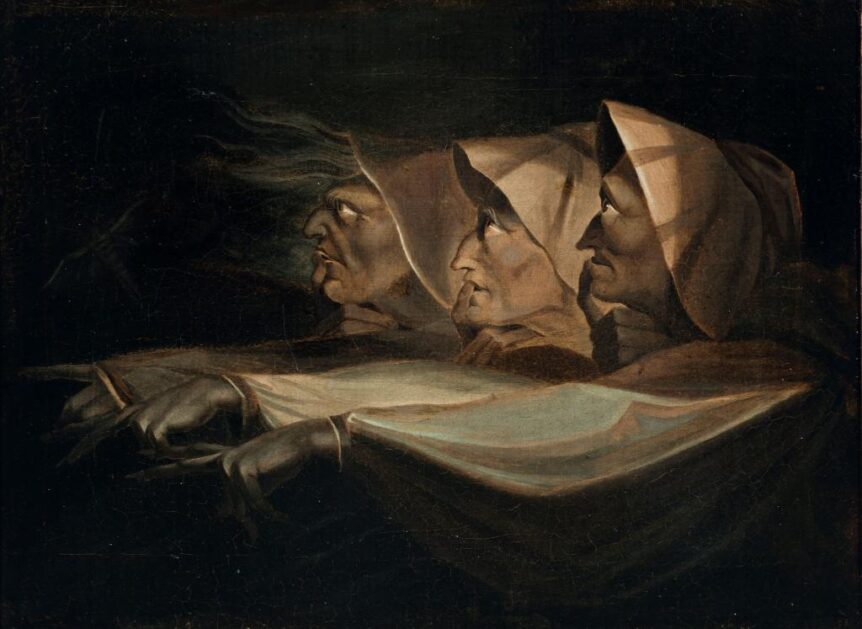
LIVING IN THE EVIL OF MACBETH’S WORLD
Fair is foul, and foul is fair.
Hover through the fog and filthy air.
– Macbeth Act I, Scene I
By Cory Franklin
January 3, 2025
It’s just as Shakespeare described it in Macbeth: a world that exists in a moral abyss, where people are unable to identify evil when it appears right in front of them. Comes now Luigi Mangione, a folk hero, too many. As his prosecution proceeds, the man who allegedly killed the CEO of United Healthcare in cold blood by shooting him in the back, has been glorified in many circles and lionized on social media, including a fundraiser that has raised nearly $200,000 for his legal defense.
This is the latest manifestation of a disturbing trend in our society of evil being ignored or allowed to flourish. It became evident after the October 7 massacre in Israel, when so many publicly supported Hamas – not the Palestinians, but the rapists and killers of Hamas. In many countries, more than a few called for violence against innocent Jews and some actually carried it out.
Rather than a cry for social justice, this was a celebration of evil. It was not a strictly American phenomenon – it was evident across the Western world from Australia to Canada to Western Europe.
And here is the handsome but vicious alleged young murderer, whose name was wildly applauded by a Saturday Night Live audience when it was mentioned. A former federal prosecutor observed he’s never seen an alleged murder receive such sympathy. It might seem like the inability to recognize evil is a flaw in young people – Mangione’s approval rating in one poll comes out positive or even among respondents 44 and younger. Perhaps it is explained by a generation that has gradually become unmoored from the lessons of morality that literature and religion teach. Their only exposure to “evil” are the villains in superhero movies and video games. If the bad guy isn’t wearing a Nazi uniform or a Ku Klux Klan robe, it’s difficult for the young to identify evil.
But attributing this moral void only to the young would be a mistake. After all, it was the geriatric set that is responsible for failing to teach younger generations. There are Ivy League professors on board with the killer.
Geezers including Michael Moore (age 70), Elizabeth Warren (age 75), and Bernie Sanders (age 83) have all legitimized the murder, at least with “I condemn murder but…” Always watch for that “but.”
And while most of those who fail to condemn Mangione (or who support Hamas) are on the Left, there is some divide across the political spectrum. Podcaster Joe Rogan has, at best, offered a muted criticism of the alleged murderer, and Mangione’s writings appear to praise conservative broadcaster Tucker Carlson. The right-wing groups of Western Europe are in synch with the Hamas strategy to kill all the Jews. Unfortunately, the failure to recognize evil transcends political partisanship.
What exactly does the murder of the UnitedHealthcare CEO actually accomplish? It probably redirects more money from insurance premiums away from health care and into personal security for executives, a paltry sum in the grand scheme but exactly the opposite of what the assassin no doubt intended. Besides being evil, it was, as the saying goes, a futile and stupid gesture.
And how could killing a CEO improve the shambolic nature of health insurance? Actuaries, not executives, determine the payout rate an insurance company provides, and their primary goal is to keep reimbursement costs low. In theory, policyholders benefit from this because lower costs should help restrain the growth of premiums.
Moreover, healthcare blogger Noah Smith writes that UnitedHealthcare’s net profit margin is roughly half that of the average S & P 500 company. If the company directed all its profits into more coverage, the amount of health care it would be paying for would be only about 10% more than what it presently provides.
Healthcare writers David Cutler and Michael Millenson have described the expensive nature of the American health insurance industry as being largely the result of factors beyond a CEO’s control. Cutler attributed much of it to administrative inefficiency and bureaucratic excess, not only on the part of the insurers but on the part of hospitals and healthcare providers. Millenson claims much of it is the result of unnecessary testing and treatment as well as questionable billing practices by doctors. Action by Congress including encouraging greater competition, greater price transparency and facilitating interstate sales of insurance could help remediate the situation.
Murdering CEOs will do nothing to change the healthcare equation, but it will alter the moral equation – to our collective detriment. We will exist in Macbeth’s Inverness, where evil is the coin of the realm.
Perhaps those who no longer recognize evil should go back to the Lord’s Prayer: Lead us not into temptation but deliver us from evil. There is evil everywhere, probably no more than there has always been. And singing the praises of murderers is nothing new – Bonnie and Clyde were rural heroes; John Dillinger had a significant fanbase – but something is different today. Cruelty and evil are not simply ignored, they are celebrated, with a contribution from social media, where fans of vicious acts can cheer those acts along with kindred shallow thinkers.
America – our parents, schools, and religious institutions – should go back to teaching our young people to recognize and call out evil. As the Russian writer Aleksandr Solzhenitsyn noted, “The line dividing good and evil cuts through the heart of every human being.” Society’s mission is to turn that thin line into an impregnable wall.

-30-
Dr. Cory Franklin
Cory Franklin, physician and writer is a frequent contributor to johnkassnews.com.
He was director of medical intensive care at Cook County Hospital in Chicago for more than 25 years. An editorial ng the pathologists who studied it intently but had no idea what body part it could be. This was before it was known as trolling.)
There is a lesson here. The next time someone tells you, with unmistakable conviction, that he believes in “the science,” gladly offer to discuss science with him over a sandwich. Give him a choice, chorizo or perhaps kosher salami. board contributor to the Chicago Tribune op-ed page, he writes freelance medical and non-medical articles. His work has also appeared in the New York Times, Jerusalem Post, Chicago Sun-Times, New York Post, Guardian, Washington Post and has been excerpted in the New York Review of Books. Cory was also Harrison Ford’s technical adviser and one of the role models for the character Ford played in the 1993 movie, “The Fugitive.” His YouTube podcast “Rememberingthepassed” has received 900,000 hits to date. He published “Chicago Flashbulbs” in 2013, “Cook County ICU: 30 Years of Unforgettable Patients and Odd Cases” in 2015, and most recently coauthored, A Guide to Writing College Admission Essays: Practical Advice for Students and Parents in 2021.
Comments 30
Thank you,Cory.
Kids that have grown up with social media games seem to lack an empathy and morality chip. They’ve been numbed by it all. Sadly parents enable this by allowing so much screen time when the kids are young.
Oh, make room for me on that soapbox.
For years (okay, decades) as a professional who works with families, I have attempted to educate parents and teachers of the inherent dangers that accompany plugging children into the Matrix.
My warnings have, for the most part, fallen on deaf ears. People protest that the world is wired for computers, and you can never start children too young – whilst they thrust a handheld device at their infants, showing them how to swipe the screen for instant gratification.
As you noted, CW, children with screen exposure between the ages of 0-5 years demonstrate no empathy. By the time they’re seven years old, zero morality.
Add to this the fact that we have a generation of children who have grown up masked, like the adults around them. Without seeing faces and expressions, developing children do not receive the required mirroring experience that helps them to develop strong character, nor the ability to relate to those around them. Neither do their parents relate to their children, as they have enjoyed limited smiling, laughing, crying experiences with their babies/toddlers.
Yes, Cory, “fair is foul, and foul is fair,” or as the Bible warned, people are calling evil “good,” and calling good “evil.”
Mangione murdered a man in cold blood. He set himself up as prosecution, judge, jury, and executioner. And it is WRONG, as are the people who defend his actions.
So well said, Ivy. I’m fortunate my children (millennials) believe in not thrusting a screen in front of their kids. Our grandchildren are empathic, conversant, imaginative, and friendly. And yes they can all navigate school approved electronics and complete assignments, as needed, but no video games in these homes yet.
Scary
Cory, thank you for highlighting the failure of our educational process to teach basic morality and also that of parents enabling the early and excessive use of computers that distracts young people from learning the importance of “others”.
The western world pushed God out of education, and churches and synagogues certainly haven’t defended Judeo-Christian morals well. Russell Kirk, in his excellent book, The Roots if American Order, directly links the Biblical foundations from the 10 Commandments and the rest of both the Old and New Testaments to the ability to have both liberty and order. Where a Creator God and personal accountability to Him and the existence of absolute moral truths (Thou shall not murder) no longer exists at a sufficient level by personal acknowledgement in society (taught by education (schools, churches, synagogues and mostly parents) order can only be maintained by force (e.g., police states like Russia, China, Iran, etc.). It all comes down truly to the questions, does God exist, and if so, has God made all humanity in His image, as the book of Genesis states and, therefore, special! If those are truths, then taking another’s life (see first murder of Abel by Cain), is an inexcusable violation of God’s direction to man . Of course, if there is no God that people need to fear in their minds, than anything goes, and spiritual evil laughs at the ignorance of humanity and the descent of the ignorant into a moral abyss. It is both a personal catastrophe for one’s soul (not acknowledging God) and a human societal catastrophe as evidenced by the acceptability to many of murdering someone made in God’s image!
Hits the mark, Dr. Franklin. This evil act reminds me of Paul Simon’s “Boy in the Bubble” lyrics:
“There was a bright light
A shattering of shop windows
The bomb in the baby carriage
Was wired to the radio”
and later…
“It’s every generation throws a hero up the pop charts”
That we have both terrorism (evil) and hero in the same song is bizarre. Yet here it is.
The topic of health care strikes a deep nerve in the heart of America. Throwing the killer of a husband and father as a hero up the pop charts is evil and, once again, polarizes people on the core issue the same way the BLM riots did nothing for racial equity and actually may have backfired.
It is a true act of cowardice to kill a defenseless person. Although I am probably mythologizing, I can respect the old morality of standing man to man if you wish to do away with that person if one accepts the challenge. Aaron Burr was the better shot on the day he killed Alexander Hamilton. For Mangione’s of cowardice, shooting an unarmed man in the back, Mangione did he would have been taken into custody. Had an immediate trial and then the rope after being found guilty. These were the ways of the Old West. Maybe we need to bring them back.
Agree. Hang these bastards !!
And televise it !
Silence over the pervasive evidence of evil is itself evil.
And the malignancy is more bold now then I can recall.
We cannot condemn and ostracize in sufficient volume those worshipping the slaughter of innocents. In Gaza, New York or New Orleans. Maybe if they won’t appropriate morality they will at least discover shame.
” The failure to recognize evil” is the the key to this brilliant analysis of our times. Yeats’ Center has not held for decades.
The Weird Sisters (American Media & K-Street) have goaded talentless MacBeth’s to bespoil the world.
It will take time and humilty to center this goofy. world once again.
Perhaps it’s not as widespread as you think. The ‘praise’ is mostly online, the realm of trolls, copycats, and anonymous hecklers. In my school, an inner-city HS, he’s neither ‘hot’ or a hero. ‘Creepy’ was the usual comment I overheard during Cafeteria or Breakfast duty. None, to my knowledge, have parents working in health insurance [though a couple are secretaries in auto insurance companies or in urgent care outlets].
Overall, a great read. The sentiment behind, “What exactly does the murder of the UnitedHealthcare CEO actually accomplish?” is spot-on. So is the highlighting of “unnecessary testing and treatment as well as questionable billing practices by doctors”.
But (always watch for that “but”) !!!
“Actuaries, not executives, determine the payout rate an insurance company provides, and their primary goal is to keep reimbursement costs low”?
No!! That is not even one of the goals of an actuary, let alone a primary one.
Generally speaking, health & benefit actuaries analyze loss data (medical & hospital costs of procedures, disbursement rates, etc) and forecast future disbursements and loss rates per exposure unit.
Actuaries do not control the gatekeepers that decide who is eligible for what level of treatment, the underlying issue that triggered Luigi.
Let’s put abortion in the same category. The murder of babies, in what should be the safest place in the world, a mothers womb, is continually celebrated by the left and the party of death, the democrats.
I know a lot of ‘conservative, right leaning’ women who have had abortions. It’s not a only left thing.
I know a few also, evil strikes everywhere, but the left seem to welcome it with open arms.
Listening to a lot of the pro evil people being interviewed, one often hears their lack of knowledge of what they are supporting. There seem to be mobs of lost souls saying “hey, look at me, my life now has meaning.” The causes may not be as important to them as the attention and peer group acknowledgement they are getting.
Excellent observation, Tim.
Far too many base their worthiness on the level of attention they receive. It seems that the louder they can shout, the more outrage they express, and the more bizarre their causes, the more value they place on themselves.
They contribute nothing but hatred and fear. And oh! The fear! To them it is the highest virtue to be afraid, and then more virtuous still to force that terror onto others.
Medicare for all is necessary
Yes! Then nobody wins. Great idea.
The currently popular phrase invented by the youngest among us is “no worries”. It’s a very common response to being confronted with fear or doubt or concern expressed by others. It’s even said in response to being thanked for doing something good or helpful. It’s like a disconnect from personal involvement or caring. It bespeaks a level of indifference that is almost scary. It is symptomatic of the severance of sympathy or empath hy from emotional feeling–there is no heart in it.
Excellent essay. I doubt the killer had any appreciation as well, for how difficult it is to run a business, any business, especially Healthcare. While it might very well be reprehensible that UHC is particularly skilled in denying claims, there are those special few Doctors who are scared to death to miss a boat payment as well.
One claim UHC denied was a $500K Hospice claim. Obviously off site, high end Hospice. Not sure this has anything to do with good vs evil, as opposed to the deterioration of the family and respect and sacrifice for our Elders. My father’s last happy day on Earth, was the day before my sister informed him that they were moving him to high end offsite hospice. My Dad then made a business decision. He decided to die.
WRT to the former “Ivys” – they have never educated anyone, since back when they were borne out of New England Divinity schools. They indoctrinate. If you go to one, it becomes a survival test and not much more.
Great piece Doctor Franklin.
The victim Brian Thompson was a husband and father to two sons. He was loved and cherished by many.
what did the Thompson family do to anyone to lose a Dad, to deserve to be reminded of a loved ones death for eternity on security footage.
May he rest in peace. Quick Eternal Rests and Our Fathers, for Brian Thompson and his survivors.
Us older folks still have empathy for our fellow man. This generation raised on cable tv and video games of violence, look at death and suffering like it doesn’t exist.
No feelings or conscience.
I witnessed it nightly in the city we both love Doc. Young men bleeding out in their final minutes of life, as we lifted their legs, held their hands, asked can i tell your mother anything, your family. All I got was the gang stuff. Try to say the Our Father, for a youth I knew was transitioning to another place, and many never knew the prayer, or a conception of God.
Same in the interview rooms. We have killers on video, eye witness identification, these mopes had no remorse or conception of sorrow, another persons suffering and pain.
No conscience, no fear of being locked in a cage..
I worry for society because of what we witnessed after Oct seventh. Civilized people condoning murder, sexual assault and kidnapping. Protests on American campuses in support of Hamas.
These are the same people supporting Luigi Mangione, a coward who attacked an unarmed man. The hero who did not face his victim.
Mangione grew up in wealth and had the best of everything. With his wealth and education he could have become an advocate for health care. Mark my words with his wealth he will buy lady justice. Be another John Hinkley.
Too bad New York doesn’t have the death penalty.
Thanks Doc and JK.
Agree 110% with the stated position on this being unquestionably”evil” along with the screaming need for action by Congress to update our nation’s health insurance system, one that largely came into place following WW2.
This piece’s correct argument that murder is evil is weakened/distracted by the economics discussion midway through when you consider that United Health is a public, profit seeking company:
— it is a growth stock part of the Dow Jones Industrial index and is up 75%+ in the past five years, currently paying a 1.6%+ dividend
— its 10 year stock performance is ~ +500%
— a former CEO walked away with a ~ $1 billion stock payout a couple decades ago
The middle section also opens up the question: is it morally correct for an entity in the middle of our people’s health care to even have a positive profit margin, let alone one “roughly half that of the average S & P 500 company”?
Unfortunately, politicians in Congress lack the moral compass to even *start* taking action to update & improve our nation’s health care system.
Well said Todd. Murder is wrong. But there are multiple ways of doing it, like denying care to desperately ill patients. There are private practice MDs that lost their license to practice with some going to jail because when medicare/medicaid denied care ie a medication, the physician then bought it for their patients from their own funds. Govt at its best. Doctors go to jail but big shot CEOs dont. Check out WSJ article 12/31/24. ‘UnitedHealths Army of Doctors it Helped Boost Medicare Payments’ ILLEGALLY!!!!!!!! The company FORCED MDs to follow a check list of potential diagnoses when examining patients. The problem was the lists were irrelevant or wrong!!!!! The diagnoses offered just happened to bill MORE MONEY for the insurance company. IOW the MDs were forced into wrong diagnoses. When a few brave Dr’s. fought that they were threatened with termination if caught by one of the employees who code the diagnoses for bigger payments.
That’s fraud and abuse but nothing will happen to the bosses of these insurance companies because they never go to jail they just pay the fines if caught. Maybe if some of these high paid executives spent time in the slammer our costs would go down.
As psychologists continue to remind us after each horrific event of murder or a mass killing, STOP giving the accused person notoriety. Do not refer to the accused by name but instead reference him or her only as the “accused killer”.
Those who seek the notoriety they cannot obtain are potentially vulnerable to performing a copycat crime to satisfy their need.
It will never happen because you cannot count on a media that has dropped to the standards of The National Enquirer to do what’s right.
Great close Doc
“The line dividing good and evil cuts through the heart of every human being.” Society’s mission is to turn that thin line into an impregnable wall.
Someone once asked me how a loving God would allow evil to exist. I responded that “evil” per se, doesn’t exist. When good is missing where it should exist, we call it evil. If it were possible to take the essence of an orange away from an orange, what would it be? You would have to create a word to define the lack of orangeness. Evil is the word we use to define a lack of goodness where goodness ought to be.
When Jenner and his team accidentally found Penicillin for small pox, just as Flemming and team did contemporary work on pasteurization and and h0mogenization. The dueling claims as to who dicovered immunolgical fixes as time went by: honed in on Onesimus, William Augustus Hinton, Julian H. Lewis, and Ellamae Simmons.
And of course we know the big egg takes credit, as Rosalin Franklin earned less recognition for her work on DNA X-ray spectrosocpy. And for her troubles in the House of Jt. Judge she died of radiation cancer.
Sorry for last word salad comment. I was half awake. Macbeth is one of Shakespeare’s major plays I haven’t seen or read. I know the plot, with Macbeth, MacDuff, Lady Macbeth, Duncan, the three witches and Banquo. I know the notorious line, “Out damn spot,” Lady Macbeth’s feeble attempt at washing away her sins. I know the ghost and apparition elements of the play as Banquo appears as a poltergeist.
But mostly it reminds me of the movie by Clint Eastwood in his heyday, Mystic River. A modern retelling of sorts of Macbeth, it’s set in Boston I believe. There are three friends biking down the road when a large DeVille stops the kids and tells Davey they’re with the police and to come with them or he’ll get in trouble. In the car is an actual policeman, a priest and a third undefined character. Not knowing any better he goes with them and suffers horrible abuse.
The story flashes forward three or four decades. The other two friends are a cop and gangster. Davey, played by Tim Robbins, is forever traumatized by what happened and is reserved, withdrawn, spooked.
Kevin Bacon plays the cop who finds the daughter of Sean Penn, the gangster, raped and dead in a local creek. The movie advances at a fast clip. Eventually Penn’s character comes to blame Davey and his moll wife orders Penn to kill him, which he does. Weeks later DNA evidence comes in exonerating Davey. The last scene is indelible in my mind: Penn fighting back tears as he stares out the window, his manipulative wife rubbing his shoulders. “You had to do it,” she says. “You had to do it.”